
This post contains affiliate links. We may earn a small commission when you buy through our links — at no extra cost to you.
A speed ladder looks like a simple piece of gear—until you’re the one untangling it in the driveway while a player waits to run drills. The best basketball speed ladders stay flat, roll up without turning into a knot, and survive repeated setups on concrete, hardwood, and grass. They turn a few minutes of footwork into a habit that actually sticks, which is why coaches, parents, and players keep one in the car. The right ladder makes quick feet feel like a game, not a chore.
We ran fourteen ladders through three months of driveway sessions, gym practices, and park workouts, paying attention to which ones stayed put during lateral shuffles and which ones came out of the bag already tangled. A cheap ladder that bunches up or sheds a rung mid-drill costs more in frustration than it saves, and even a well-made one is only worth it if it folds small enough to live in a duffel. The picks below are the ones that held their shape, packed away cleanly, and kept players coming back for another round.
Our Top Picks




The Best Basketball Speed Ladder, Reviewed
Power Guidance Ladder – Best Overall
Key Features
- Included: 10 cones, 4 pegs, carry bag
- Rung spacing: Adjustable
- Rung material: Heavy-duty plastic
- Length and rungs: 20 ft, 12 rungs
- Price: Midrange
The 20-foot, 12-rung layout and four pegs make the Power Guidance ladder our default for basketball footwork. A 20-foot ladder gives you enough runway to chain two or three moves without resetting, and the rungs adjust along the straps, so you can tighten the spacing for quick feet or open it up for bounding strides. The four pegs are the detail that separates it from most ladder-and-cone sets here: on grass, they hold the ends down; on a gym floor, leave them out and the flat plastic rungs still lie straight.
The ten cones earn their place, too. You can set a ladder down the middle and use the cones for change-of-direction work at the ends, which is closer to how basketball quickness shows up than a ladder alone. We also like that everything fits in the carry bag; the set is light enough to move from trunk to court without a second trip. The adjustable rungs take a little care to set evenly, so measure once rather than nudging every rung after the first drill.
Against the other picks, this is the one that covers the most ground for the least fuss. The SKLZ is better in a tight gym, and the MANTRA has the longer warranty, but neither gives you the same combination of length, pegs, and cones. For a player who trains on grass and court, it is the easy first choice.
Pros
- 20-foot length leaves room for longer combinations
- Adjustable rung spacing suits different footwork drills
- Four pegs and ten cones cover outdoor setups
- Carry bag keeps the kit together
Cons
- Can arrive tangled; needs patient first setup
We recommend the Power Guidance ladder as the default for basketball footwork: 20 feet of adjustable rungs, four pegs, and ten cones cover court and grass sessions.
MANTRA Ladder Set – Best Complete Set
Key Features
- Included: 8 cones, carry bag
- Warranty: Lifetime
- Rung spacing: Adjustable
- Length and rungs: 19.6 ft, 12 rungs
- Price: Midrange
A lifetime warranty is unusual in this group, and the MANTRA set backs it with a 19.6-foot, 12-rung ladder, eight cones, and a carry bag. The rungs slide along the straps so you can set the spacing for a young player’s short steps or an adult’s longer strides. Bright yellow is easy to see on a gym floor or in grass, and the 19.6-foot length is long enough for most backyard and practice-court drills.
This is the set we hand to a family buying its first serious ladder. It covers the essentials without turning into a full training kit: ladder, cones, bag, and a warranty that takes some of the risk out of the purchase. We also appreciate that the rungs are adjustable; a fixed ladder forces one rhythm on every drill, while this one lets you change the cadence.
There are no ground pegs in the set, so on grass you may want to add a couple of tent stakes or weights at the ends; indoors, that is a non-issue. The Power Guidance adds pegs for similar money, but the MANTRA answers with the stronger warranty and a slightly shorter footprint. If you want one ladder that will handle a family’s practices and last through a few seasons of use, this is the safer buy.
Pros
- Lifetime warranty backs the purchase
- Adjustable 12-rung ladder
- Eight cones and carry bag included
- 19.6-foot length suits most drills
Cons
Our pick for a first serious ladder is the MANTRA set, which pairs 12 adjustable rungs with cones, a carry bag, and a lifetime warranty.
SKLZ Quick Ladder – Best for Tight Spaces
Key Features
- Included: Carry bag
- Rung width: 17 in
- Item weight: 9.88 oz
- Length and rungs: 15 ft, 11 rungs
- Price: Midrange
The 17-inch rung width is why the SKLZ Quick Ladder stays in our gym bag. Wider rungs give your feet a clearer target on lateral and in-and-out drills, and that matters more for basketball than a long runway you never use. The ladder is 15 feet long with 11 rungs, light enough to carry with one hand, and it rolls into the included bag without much bulk.
In a basement, driveway, or crowded gym, it is easier to place than a 20-footer, and you can still run quick feet, icky shuffle, and single-leg patterns. The SKLZ has no stakes, so on grass the ends can lift; a couple of weight plates or a non-slip mat under the ends solves it indoors. We treat it as a compact gym ladder rather than a long-runway trainer.
The wide rungs are the reason we keep coming back, and the compact frame is easy to live with. If your training space is tight, this is the ladder we hand over first.
Pros
- Wide 17-inch rungs aid foot placement
- 15-foot frame fits tight spaces
- Lightweight with carry bag
- Simple to set up and store
Cons
- Straps can twist when folded quickly
We keep the SKLZ Quick Ladder in the bag for tight gyms, where its wide 17-inch rungs and 15-foot frame make quick footwork easier to place.
MUROZA Training Set – Best All-In-One Kit
Key Features
- Included: 12 cones, parachute, jump rope, carry bag, guides
- Ground stakes: 4
- Hurdle heights: 8.5–12 in
- Length and width: 20 ft, 16.7 in
- Price: Premium
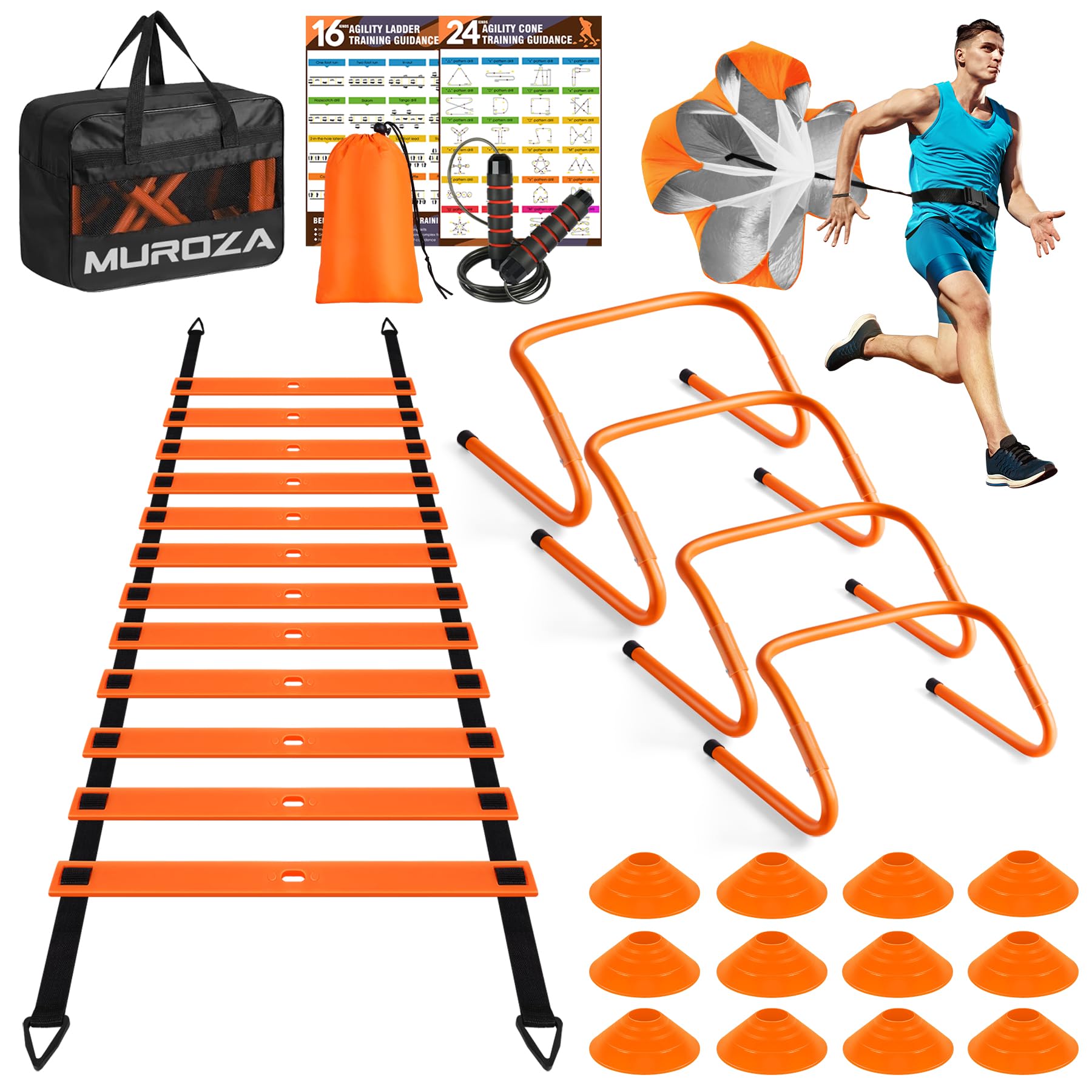
The MUROZA kit opens into a full speed session: a 20-foot ladder that is 16.7 inches wide, four adjustable hurdles from 8.5 to 12 inches, 12 cones, a parachute, a jump rope, four stakes, a carry bag, and training guides. The hurdles rotate to different heights, so you can use them for lateral steps, bounds, or a quick change from ladder work to barrier work.
This is the kit we recommend when you want variety without buying three separate products. The ladder is the core, but the hurdles make it easy to add a second station, and the cones set up a change-of-direction finish. The parachute and jump rope are extras rather than the reason to buy; they add conditioning options, but the ladder and hurdles are what earn the space.
The catch is bulk. This is a larger, heavier set than a ladder-and-cone bag, and it takes more room in the trunk. If you only need footwork, the MANTRA or Power Guidance is easier to live with. If you coach a small group or want a backyard circuit that changes every few minutes, the MUROZA is the one we reach for.
Pros
- Ladder, hurdles, parachute, and jump rope in one kit
- Adjustable hurdles span 8.5 to 12 inches
- Four stakes and 12 cones support outdoor sessions
- Carry bag keeps the full set together
Cons
- Premium price for the full kit
If you want one box to cover speed, hurdles, and resistance work, we think the MUROZA kit earns its space.
YISSVIC Ladder Set – Best Budget with Stakes
Key Features
- Width: 15.7 in
- Included: 10 cones, 4 metal pegs, carry bag
- Warranty: Lifetime
- Length and rungs: 20 ft, 12 rungs
- Price: Budget
The four metal pegs are the reason the YISSVIC belongs on a budget shortlist. You get a 20-foot ladder with 12 adjustable rungs, ten cones, the pegs, and a carry bag, which is more complete than most sets at the bottom of the price range. The rungs are 15.7 inches wide, a little narrower than the SKLZ but still generous enough for straight-ahead footwork.
On grass, the pegs make the biggest difference: they hold the ends down so the ladder does not skate when you push off. On a gym floor, leave them out and the plastic rungs sit flat enough for short drills. The rungs adjust along the straps, though you need to set them evenly before you start; otherwise the spacing drifts and you spend the session fixing it.
We reach for this one when the budget is tight and the training happens outdoors. The ladder and pegs do the real work, and the carry bag keeps the set together. It is not the most refined kit here, but it covers the basics for a player who needs staked 20-foot drills without paying for a full coaching kit.
Pros
- Four metal pegs steady outdoor setups
- 20-foot ladder with 12 adjustable rungs
- Ten cones and carry bag included
- Budget-friendly staked kit
Cons
- Cones are light and can arrive bent
For budget-minded outdoor players, we point to the YISSVIC: a 20-foot adjustable ladder, four metal pegs, and ten cones.
AlphaWorx Ladder – Best for Small Indoor Spaces
Key Features
- Modes: Ladder, hurdle, wall
- Rungs: 8
- Setup: Folds flat
- Material: Polypropylene, spring steel
- Price: Premium
The AlphaWorx folds flat into a small bundle, which is why it stands apart from the long roll-up ladders here. It uses a spring-steel frame and polypropylene rungs, with eight rungs in the standard version, and it can be shaped as a flat ladder, a set of low hurdles, or a wall. Setup takes seconds once you get the fold pattern.
That flexibility is useful in a basement or a small court where a 20-foot ladder eats the whole space. You can run straight patterns, bend the ladder into a curve, or raise sections for hurdle work. The low hurdle height suits younger players and quick lateral steps; it is not a replacement for a full hurdle set.
The eight-rung length is the limit. For advanced combinations that need a long, uninterrupted run, the Teenitor or Power Guidance is the better tool. The AlphaWorx is the one we choose when storage and setup speed matter more than maximum runway, and for a small indoor space that trade is easy to make.
Pros
- Folds into a compact bundle
- Works as ladder, low hurdles, and wall
- Spring-steel frame holds its shape
- Fast setup on small courts
Cons
- Can be stiff to fold at first
We like the AlphaWorx for basements and small courts because it folds into a compact bundle and doubles as low hurdles.
Teenitor Ladder – Best for Advanced Long Runs
The Teenitor’s 23-foot run is the longest here, with 13 rungs and nylon straps that adjust the spacing. The extra length is not a gimmick: it lets you set three or four different zones in one line, so you can move from quick feet to a wider stride without stopping to reset. The green rungs are UV-resistant, and the set packs into a carry case.
For a basketball player working on open-floor footwork, that length is useful. You can run a long combination, keep your rhythm, and finish with a change-of-direction step. The 13-rung layout gives more contact points than a 15-footer, and the adjustable straps let you shorten the spacing for younger or less experienced players.
The trade-off is handling. A long ladder has more strap to manage, and this one can tangle if it is stuffed into the bag rather than rolled. The rungs can also shift on a smooth surface, so on a gym floor, weight the ends or use a mat. On grass, the setup is stable enough for straight-line work.
We pick the Teenitor for advanced players who want to chain moves without resetting. For long, continuous combinations and a ladder that grows with a player, this is the one to choose.
Pros
- 23-foot length supports long combinations
- 13 rungs with adjustable spacing
- UV-resistant rungs and carry case
- Light package for its length
Cons
- Needs a long, clear lane
The Teenitor is the one we reach for when a long, continuous run matters; 23 feet and 13 rungs leave room for advanced combinations.
GHB Pro Ladder – Low-Cost Spare

Key Features
- Included: Carry bag, drills guide
- Rung width: 16.5 in
- Rung spacing: Adjustable up to 15 in
- Length and rungs: 20 ft, 12 rungs
- Price: Budget
The GHB Pro is the lowest-priced route to a 20-foot ladder in this group, and it still gives you 12 rungs, 16.5-inch width, adjustable spacing up to 15 inches, and a carry bag. The rungs are plastic and light, the whole package weighs about as much as a water bottle, and the included drills guide gives a beginner a place to start.
For a coach who wants a spare ladder for a team bag, or a parent testing whether a young player will stick with footwork drills, that low entry point makes sense. The ladder lays out long enough for most basketball patterns, and the adjustable rungs let you shorten the spacing for beginners. It is not a precision instrument, but it does the basic job.
The low price is the point. The GHB Pro gives you the same 20-foot footprint and adjustable spacing as ladders that cost more, so the savings go into the hardware rather than the layout. We treat it as a second ladder or a trial set, not the one we grab for every session.
We still see a place for it: a second ladder, a team spare, or a low-cost way to try ladder training before committing to a better set. If you plan to use one several times a week, spend more. If you need a long ladder for occasional drills, the GHB Pro earns its spot.
Pros
- Lowest-cost 20-foot ladder here
- Adjustable spacing up to 15 inches
- 16.5-inch rungs and carry bag
- Very light to carry
Cons
- Rungs slide during hard pushes
- Can arrive badly tangled
The GHB Pro is the least expensive way to get a 20-foot adjustable ladder, and we see it as a spare or trial set.
How We Tested Basketball Speed Ladders
We started by pulling together a shortlist of ladders that popped up in coach recommendations and player forums, then filtered for adjustable rung spacing, flat straps, and a carry bag that didn’t look like an afterthought. Fourteen made the cut. Over three months, we set them up on a concrete driveway, a hardwood gym floor, and a patch of park grass, running the same footwork drills on each surface.
Every session started with a stopwatch: we timed how long it took one person to unroll the ladder, straighten the rungs, and get it flat on the ground. We noted whether the straps lay flat or curled at the edges, and whether the ladder slid during lateral shuffles on smooth gym floors. After each drill set, we rolled each one back up and checked for tangles—some ladders needed a second pair of hands, others coiled neatly into their bag. We also inspected rung connections and strap stitching after every session, looking for fraying, loose knots, or cracked plastic.
To judge versatility and fun, we ran the same ladders through straight-line drills, lateral patterns, and single-leg hops, then asked players to rate how willing they’d be to use it again. Portability was tested by stuffing each ladder into a backpack and a car trunk, and foldability by timing how quickly it rolled up and whether it stayed compact. The ladders that scored best were the ones that stayed flat during drills, survived repeated setups without shedding parts, and packed away small enough that nobody minded bringing them along. We also weighed the wear after three months against the price, because a ladder that frays by week two is no bargain.
How to Choose a Basketball Speed Ladder
The right ladder for basketball is the one you can lay flat and reset quickly, because footwork drills depend on rhythm more than on extra features.
Start with length and rung count
We treat 20 feet as the default for basketball footwork. It gives you room to chain two or three moves without resetting, while a 15-foot ladder fits a driveway, basement, or crowded gym and a 23-foot model is for advanced players with a clear lane. Rung count follows length: more rungs mean more contact points, but spacing matters just as much. The Power Guidance and MANTRA sit in the useful middle; the SKLZ Quick Ladder is the compact exception.
Prioritize stability for your surface
On grass, four ground pegs are worth more than an extra cone: they keep the ends from skating when you push off. On a gym floor, pegs are useless, so look for flat rungs and plan to weight the ends if the surface is slick. The YISSVIC and Power Guidance include pegs; the SKLZ relies on its wide rungs and needs a little help indoors. If you train on both surfaces, a pegged ladder with flat-bottomed rungs is the flexible choice.
Choose adjustable spacing, but respect setup time
Adjustable rungs let you shorten the gaps for quick feet and widen them for bounding strides. That versatility is why we favor adjustable models for basketball, where footwork changes with age and drill. The trade-off is more strap to manage and a greater chance of uneven spacing. Set the ladder once with a tape or a marked strap, and check the first two rungs before every session. Fixed-width designs like the AlphaWorx fold faster but lock you into one rhythm.
Buy only the extras you will use
Cones are almost always useful: they mark starts, finishes, and change-of-direction points. Hurdles, parachutes, and jump ropes turn a ladder into a fuller conditioning kit, but they add bulk and expense. The MUROZA kit makes sense for a coach or a family that will rotate stations; a player who only wants footwork is better served by the MANTRA or Power Guidance. Check that the bag fits everything, because loose cones are the first thing to go missing.
Plan for tangling and storage
Roll-up ladders tangle when they are stuffed into a bag, especially long adjustable models. Lay the ladder flat, fold the rungs in line, and roll from one end rather than bundling it. The GHB Pro is the budget example where tangling is a real part of ownership; folding designs like the AlphaWorx avoid the problem but give up length. If you leave a ladder in the car, keep it out of direct sun so the plastic and straps stay supple.
Frequently Asked Questions
Can a speed ladder really improve basketball footwork?
Yes, if you use it for short, sharp repetitions rather than long, tired sets. Ladder work trains foot placement, rhythm, and the quick ground contacts that show up in defense and change-of-direction moves. Use it two or three times a week for 10 to 15 minutes, and keep the drills short enough that your form stays clean. It complements ballhandling and strength work; it does not replace them.
What ladder drills translate best to basketball?
Start with one foot in each square, lateral in-and-out steps, and the icky shuffle. Keep your hips low and your eyes up, as if you are tracking a ballhandler. Run each pattern for 20 to 30 seconds, rest, and repeat three times. Finish with a change-of-direction cone cut so the footwork has a basketball finish rather than staying a pure ladder drill.
Can kids use an adult speed ladder?
Yes, with shorter spacing and supervision. Set the rungs closer together so a young player can land cleanly, and keep sessions short; five to ten minutes is plenty at first. Check that the ladder lies flat and the ends are secure before every use. A 15-foot ladder is easier for a child to manage than a 23-foot model, but drill quality matters more than length.
Final Verdict
For most basketball players, the Power Guidance ladder is the one to buy: 20 feet of adjustable rungs, four pegs for grass, and ten cones make it a complete footwork station without the bulk of a full kit. It is the pick we trust for both driveway and court sessions.
The MANTRA set is the better call if a lifetime warranty and a slightly shorter ladder matter more than pegs, while the SKLZ earns its place in a cramped gym. If budget decides, the YISSVIC gets you staked 20-foot drills for less.