
This post contains affiliate links. We may earn a small commission when you buy through our links — at no extra cost to you.
Weight has to go somewhere, and on a weighted vest it goes across your shoulders and ribs — which is why a badly built one announces itself before the first drill is over. The good ones hold the load flat against your torso, stay quiet when you cut, and let you shoot the way you shoot without them.
I’ve worn one for conditioning work for a couple of years now, and a bouncing vest will quietly shorten your defensive slide whether you mean it to or not. Over the past six months, we tested 12 vests the way players actually use them: on a rec-center court, in a driveway, and on the runs in between.
The heaviest vest you can strap on is rarely the one that helps. Most players get further with 10 to 20 pounds they can add to over time, and adjustability matters more than max load — a vest you can’t cinch down is just a 20-pound pendulum swinging off your collarbones. The padded, sweat-hungry ones can also smell like a gym bag by week two, which we checked for. Below are picks for court work, for running, and for both.
Our Top Picks


The Best Weighted Vests for Basketball Training, Reviewed
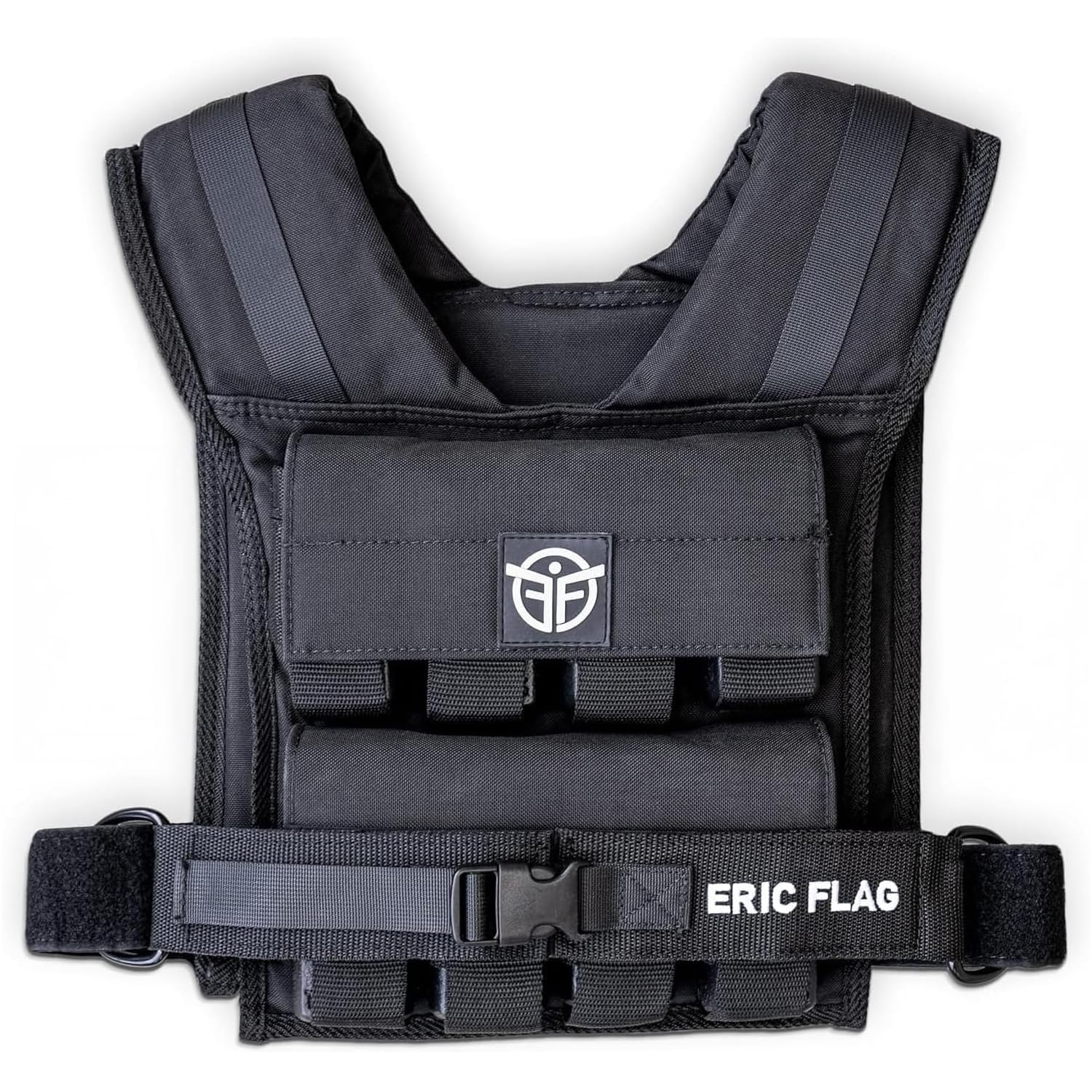
Eric Flag 40 lb Weighted Vest – Best Overall
Key Features
- Empty weight: 1.6 lb
- Shell material: 1000D Oxford nylon
- Adjustable load: 0–40 lb
- Weight increments: 16 removable 2.4 lb weights
- Price: Premium
Sixteen small iron weights, 2.4 pounds each, are the reason this vest works for basketball: you can set it at a genuinely light load for footwork and shooting drills, then add a few pieces for conditioning days without switching vests. The empty shell is light enough to handle, and the compact cut keeps the load close to your center instead of hanging below your waist.
We made it our top pick because the adjustment is fine enough to be useful, not just a token range. The 2.4-pound steps are finer than the four-pound pouches on the RUNmax here, and that matters when you are adding load to jumping and landing. We also like that the shell is compact enough to wear through ball-handling and defensive-slide work without the weights swinging away from your body.
The 1000D Oxford shell feels like the most durable material in this group, and the buckle and straps stayed snug in our movement checks. The cut leaves your arms free for overhead reaches and closeout steps, where a longer vest can catch on the hips. We noticed the difference most when we raised our arms and drove into a defensive stance; the vest stayed put instead of riding up.
If you only want one fixed weight for simple workouts, that precision is more than you need. For a player who wants one vest to cover the whole training cycle, the extra adjustment is the point, and the small weights are worth keeping organized.
Pros
- Fine 2.4-pound load adjustments
- Compact enough for dynamic drills
- Durable 1000D Oxford shell
- Secure buckle and strap fit
Cons
- Premium price compared with fixed-weight vests
For most basketball players, the Eric Flag is our default vest: 2.4-pound increments let you add load gradually without giving up a secure, compact fit.
RUNmax Adjustable Weighted Vest – Best for Heavy Progressive Loading
Key Features
- Closure: Hook and loop
- Material: Nylon
- Max load: 40 lb
- Shoulder pads: Included
- Price: Premium
The RUNmax is the vest we reach for when the session is strength-first: 40 pounds of removable load, a hook-and-loop front, and a shoulder-pad setup that makes heavier work more tolerable. It is a training tool, and that is exactly why it earns a place for progressive strength blocks.
The pouches come out in roughly four-pound steps, so you can strip it down for push-up or lunge circuits and build it back up for heavy carries. That is coarser than the Eric Flag’s 2.4-pound fine tuning, but it is still practical for a player who thinks in blocks rather than micro-loads. We appreciate the shoulder pads when the vest is loaded near its top end; they are the difference between a heavy vest you tolerate and one you avoid.
It is not the vest we choose for sprint work or fast defensive slides; this one is for slower, heavier strength blocks. The removable weights also need to go back in evenly, front and back, or the vest pulls to one side. For a player building strength in the offseason, that is a fair exchange for the load range. The hook-and-loop closure is easy to fine-tune, and the nylon shell has a reassuringly utilitarian feel.
Pros
- 40 pounds of removable load
- Shoulder pads for heavier work
- Easy to strip down for circuits
Cons
- Bulkier than compact fixed-weight vests
We reach for the RUNmax when the session turns to heavy strength blocks, where removable pouches and shoulder pads make a 40-pound load manageable.
ZELUS Weighted Vest – Best Budget
Key Features
- Fill: Iron sand
- Weight: 12 lb
- Closure: Buckle
- Chest fit: 31.5–45 in
- Price: Budget
The ZELUS is the budget option we hand to someone who wants a straightforward 12-pound vest without paying for adjustable load. The chest straps adjust from 31.5 to 45 inches, which covers a wide range of players, and the reflective trim and small pockets are useful for early-morning or evening sessions. The buckle is easy to work with, and the vest is simple to wipe down after a session.
At 12 pounds, it is heavy enough to make footwork and conditioning drills feel different, but light enough that most players can keep their shooting form. The iron-sand fill sits evenly across the front and back, and the buckle closure is quick to get on and off. We like the armband pouch for keys or a phone, though it is not a reason to buy the vest on its own. For a first weighted vest, that is a sensible balance.
We think this is the best budget pick in the group for basketball drills. The straps need a firm pull before faster cardio, but once snug, the vest settles down for controlled work. It is happiest in a straightforward routine where you put it on and don’t think about it. That simplicity is the appeal.
Pros
- Wide 31.5–45 inch chest range
- Even iron-sand weight distribution
- Reflective trim and storage pockets
- Budget-friendly fixed 12 pounds
Cons
- Fixed 12-pound load limits progression
- New-vest odor needs airing out
The ZELUS is the budget vest we recommend for fixed-weight drills, as long as you can air it out and get the straps snug.
Zikopomi Weighted Vest – Best Value Fixed-Weight
Key Features
- Straps: Two adjustable elastic
- Weight: 12 lb
- Closure: Buckle
- Reflective trim: Front and back
- Price: Budget
Two adjustable elastic straps are the Zikopomi’s best argument: they let you cinch the chest and waist separately, which is more control than a single front buckle gives you. The 12-pound fill is balanced front and back, and the reflective strips are a sensible touch for driveway workouts after dark. The buckle is easy to work with, even when you are breathing hard.
We like it as the value fixed-weight pick because it does the basic job without fuss: pull it on, clip the buckle, tighten the straps, and go. The polyester shell is soft against a T-shirt, and the whole thing stays close enough for shooting and ball-handling drills. It is not as refined as the Eric Flag, but it costs far less and asks less of you. For a beginner or a player who wants a second vest for home drills, that is a useful balance.
The fit is the catch. The straps can be cinched down for smaller frames, but the vest can still run loose through the chest on narrow builds, and it will not suit every body shape. If you are between sizes, measure your chest and compare it with the seller’s chart before ordering. It is not a precision fit tool.
Pros
- Two adjustable elastic straps
- Balanced front-and-back 12-pound fill
- Soft shell and easy on/off
Cons
- Fixed 12-pound load limits progression
A low-cost 12-pound vest that fits a wide range of bodies, the Zikopomi is our value pick, though smaller frames may need to size carefully.
NATURELUX Weighted Vest – Best for Beginners
Key Features
- Weight: 10 lb
- Closure: Buckle
- Material: Polyester and iron sand
- Shoulder padding: Padded straps and waist belt
- Price: Budget
If you have never trained in a weighted vest, the NATURELUX is a gentle place to start: 10 pounds, padded shoulder straps, and a simple clip closure. We recommend it for controlled shooting drills and conditioning because the load is light enough to keep your form from falling apart, and the waist belt keeps the bottom from swinging out. The reflective strips are a nice bonus for early workouts. It is not a vest for max-effort jumping, but that is not what this pick is for.
The materials are basic but sensible: polyester and iron sand, a buckle closure, and a 12-month warranty. It is not adjustable, so the 10 pounds is the weight you get. That makes it a poor fit for a player who wants to progress through a season, but a good fit for someone who wants one vest for warm-up routines and walk-through conditioning. The shoulder and waist padding are the parts we appreciate most; they take the sting out of the first few sessions. The clip is easy to operate with one hand, which matters when you are moving between drills. We also like that the shell is easy to wipe clean. For a first vest, that simplicity is worth more than a long feature list.
Pros
- Light 10-pound starter load
- Padded shoulders and waist belt
- Quick one-hand clip closure
- Backed by a 12-month warranty
Cons
- Sizing is not universal
We recommend the NATURELUX as a first weighted vest for controlled drills and walks, not as a do-everything adjustable trainer.
APEXUP Weighted Vest – Shoulder Comfort Priority

Key Features
- Weight: 10 lb
- Closure: Buckle
- Material: Ironsand and neoprene
- Shoulder padding: Padded straps
- Price: Midrange
The APEXUP’s padded shoulder straps are the first thing you notice, and that is the right priority for a 10-pound vest you plan to wear through repeated shooting and defensive drills. The clip system is quick, the reflective straps help in a dim gym, and the mesh pocket gives you a place for a phone or keys. The buckle is easy to adjust with the vest on, and the outer material wipes clean easily.
The load stays at 10 pounds, so this is not a vest for a player who wants to build up to heavier conditioning. What it does well is stay comfortable: the neoprene shell is soft, the shoulder padding spreads pressure, and the fit can be tightened enough for controlled movement. The padding is thick enough that we did not feel the weight digging into the collarbone. That makes it easy to wear for longer sessions, and we found it best for warm-up and low-impact work rather than hard jumping.
We keep it as an also-consider because the comfort is real. It is a pleasant vest to wear, and that counts for something in a category where so many models feel like a sack of sand. If you already own an adjustable vest, this is a comfortable second layer for lighter days. We still reach for the adjustable picks for hard intervals.
Pros
- Padded shoulder straps spread pressure
- Soft neoprene shell against the skin
- Quick clip and reflective straps
Cons
- New-vest odor can linger
When shoulder comfort matters most, we pick the APEXUP, provided you can air it out before wearing it for close-quarters conditioning.
BAGAIL Weighted Vest – Best for Narrower Body Frames

Key Features
- Weight: 12 lb
- Closure: Buckle
- Material: Iron sand and neoprene
- Phone pouch: Detachable
- Price: Budget
Soft neoprene and a detachable phone pouch make the BAGAIL feel more like a fitness layer than a piece of ironmongery. The 12-pound fill is spread evenly, the buckle is easy to work with cold hands, and the reflective strips are a practical detail for early runs or driveway sessions.
The adjustable straps sit nicely over a T-shirt without digging in, and the soft shell moves with you instead of standing away from your body. We like it for walking and light conditioning, where the phone pouch and comfortable fit make it easy to forget you are wearing extra weight. For basketball, it is a support act rather than the main training vest: fine for warm-ups and footwork.
The pouch is genuinely useful, not a throwaway add-on: it keeps a phone off the floor and out of your pockets during a session. The soft shell also makes this one of the more comfortable fixed-weight vests here, provided the straps are tightened evenly. We appreciate that the buckle is easy to operate without looking down.
The BAGAIL makes the most sense as a soft, fixed-weight layer for warm-ups and light conditioning. If you want one vest for jumping and sprinting, the compact adjustable picks are better; if you want something comfortable for low-impact sessions, this one earns a place.
Pros
- Soft neoprene shell moves with you
- Detachable phone pouch for workouts
- Reflective front and back strips
- Even iron-sand weight distribution
Cons
- Runs small for larger chests
- New-vest odor can linger
For smaller, narrower frames, we suggest the BAGAIL, a soft 12-pound option, though shoppers with larger chests should measure first.
How We Tested Weighted Vests for Basketball
We started with every adjustable vest we could find in the 5-to-40-pound range, then narrowed by weight options, strap and padding design, whether the weights were removable or sewn in, and price relative to how much usable weight you actually got. Twelve made the cut, and we spent six months in them.
Most of the work happened on a rec-center court and a driveway hoop: defensive slides, closeouts, sprint-and-stop drills, and free throws taken after a conditioning set, when form is the first thing to fall apart. We also ran and walked in each vest, cycled through garage circuits, and timed how long it took to add or pull weight mid-session.
To track stability, we marked strap positions with a pen before each session and measured how far things had crept afterward. We wore a white T-shirt underneath to catch chafing and dye transfer, and felt along the collarbones and ribs after 20 minutes to find where the load was landing. Testers from 5-foot-2 to 6-foot-3 wore the same vests so we could see whether the size adjustment actually covered different builds.
Odor got its own test: each vest went into a gym bag still damp and came out the next morning for a sniff, repeated weekly to see which ones turned. We judged quality and value by how straps, stitching, and shoulder padding held up by month six, and by whether the weight you paid for was weight you could keep in place.
How to Choose a Weighted Vest for Basketball Training
For basketball, the right vest is the one you forget you are wearing until the whistle: secure enough for jump stops, compact enough for shooting form, and adjustable enough to change the load as your training shifts.
Decide Between Fixed and Adjustable Load
Fixed vests are simpler and usually cheaper, but you buy the load once. A 10- or 12-pound vest can be plenty for shooting drills, defensive slides, and warm-ups; it is not the tool for a player who wants to add weight every few weeks. Adjustable vests cost more and take longer to load, but they let you use a light setting for footwork and a heavier one for conditioning without buying twice. The Eric Flag’s 2.4-pound increments are the finest here; the RUNmax moves in larger steps and suits heavier strength blocks.
Fit the Vest to Your Torso, Not Just Your Chest
The straps matter, but so does the length. A vest that hangs below your waist will swing into your hips when you run and catch on your shorts when you squat. Look for a cut that ends around the natural waist, then test it with your arms overhead and in a deep defensive stance. We prefer two adjustment points because you can tighten the waist independently of the chest. The ZELUS lists a 31.5-to-45-inch chest range, which is useful if you are shopping without trying it on.
Check Stability Before You Add Speed
Bounce is the difference between a training vest and a nuisance. A secure vest should stay close during jump stops, lateral slides, and short sprints; if it lifts off your shoulders or swings away from your back, the load is fighting your movement instead of loading it. Tighten the waist first, then the chest, and recheck the front-to-back balance after changing weights. A compact vest with small removable weights is easier to keep quiet than a bulky pouch vest, which is why the Eric Flag is our first choice for fast work.
Prioritize Shoulder Comfort and Materials
Basketball training involves a lot of arm movement, so padding and armhole shape matter. Thick shoulder straps spread the load, but too much bulk can restrict your shooting motion. Neoprene and elastic shells feel soft and move with you, though they can arrive with a chemical smell; air the vest out before indoor use. If you train hard and often, a reinforced shell such as 1000D Oxford nylon is worth the extra cost because it resists abrasion and seam strain.
Measure, Then Check the Closure and Seams
One-size-fits-most is a claim, not a guarantee. Measure your chest at the fullest point and compare it with the vest’s stated range; if you are near the top or bottom, read the sizing notes carefully. Check the closure and seams before you load the vest, especially if you plan to use it for jumping and sprinting. Removable weights add versatility, but they also add pockets and seams that need to hold. A simple buckle and reinforced stitching are worth more than a long feature list.
Frequently Asked Questions
Can you wear a weighted vest during basketball games?
A weighted vest is a training tool, not game equipment. Use it for controlled drills, conditioning, and individual workouts, then take it off for scrimmages and games. If you play in a league, check the rules before wearing one in any organized session.
Do weighted vests help with vertical jump?
They can add resistance to jump and landing drills, but they are not a shortcut to a higher vertical. Keep the load light enough that your takeoff and landing stay clean, and use the vest for controlled reps rather than max-effort jumping every session. A vest is most useful as a conditioning tool, not a replacement for jump technique work.
How do you clean a weighted vest?
Most weighted vests are wipe-clean only. Remove the weights if the design allows, wipe the shell with a damp cloth and mild soap, then air-dry it completely before reloading. Do not machine-wash or tumble-dry unless the maker’s care label says otherwise.
Final Verdict
For most basketball players, the Eric Flag is the vest to buy first. The 2.4-pound weights let you keep the load light for shooting and footwork, then add resistance for conditioning, and the compact shell stays put through jumping and lateral work. It is the most expensive pick here, but it is also the one that covers the widest range of training days in this group.
Choose the RUNmax if your priority is heavy strength work and you want 40 pounds of adjustable load with shoulder pads. If you want a simple fixed-weight vest for drills, the ZELUS is our budget pick; air it out and tighten the straps before you judge it.