
This post contains affiliate links. We may earn a small commission when you buy through our links — at no extra cost to you.
A practice pinny has one job: make one team look different from the other for an hour. Most are built as if that hour is the only one they’ll ever see. Stitching lets go at the shoulder, screened numbers crack in the dryer, and three weeks in half your squad is wearing a color that matches nobody — which is how a scrimmage turns into an argument about sides. The right one keeps teams straight, survives the wash, and fits a 5’2" guard and a 6’3" post alike.
I’ve coached enough Tuesday-night practices to know that sizing is where programs get burned: a youth pinny pulled over a hoodie fits almost nobody, and "one size fits most" stops being true the moment a big post tries one on. My team and I spent a full season — about four months of practices, weekend clinics, and pickup runs — cycling 14 pinnies through the wash and back onto the floor. Cheap per unit only counts if you’re not reordering in January, and the ones that held up are below.
Our Top Picks
The Best Basketball Practice Pinnies, Reviewed
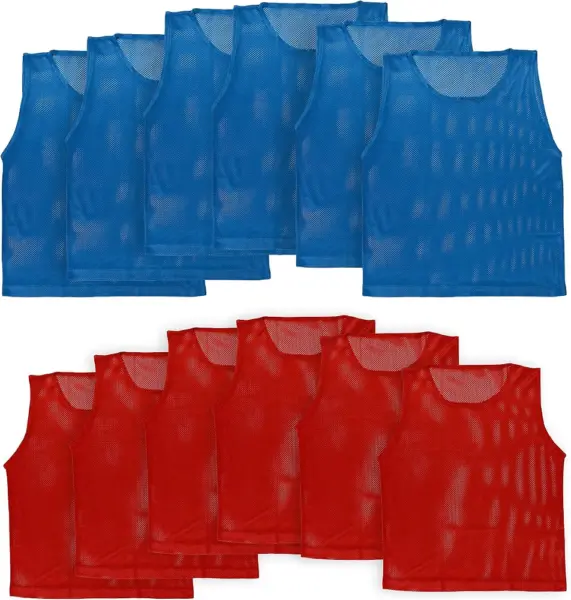
LITEMESH Practice Pinnies – Best Overall
Key Features
- Wash: Machine washable
- Sizing: Youth
- Set size: 12 or 24 vests
- Price: Midrange
Twelve vests is the number that works for most teams: five on the floor, five on the bench, and two spares for the kid who forgot his or the one who sweated through his. That arithmetic is why this set is our default, and why the twenty-four only makes sense for a program running two gyms at once.
What we appreciated once practice started is how little the vests interfere. The mesh is light and airy, so a player wearing one over a t-shirt stops noticing it by the second drill, and the colors read clearly from the far end of the court — less trivial than it sounds when you’re sorting fifteen kids into two groups. These are cut for third- through sixth-grade bodies, and that’s the range they cover best.
Sizing needs a plan rather than a guess. The smaller size is genuinely small, which suits third and fourth graders and strands a twelve-year-old, while the larger size has room to pull on over a sweatshirt without a fight. If your roster spans fourth through eighth grade, order the bigger size and let the little ones swim in it rather than splitting the order between sizes.
The test that matters over a season is the wash, and a full set comes out of a cold cycle smelling of nothing, which is more than a lot of gym kit manages. Rotating half the vests while the other half dries is how a twice-weekly practice stays ahead of the laundry, and it’s the sort of boring convenience that keeps a set in use instead of in a bag.
Pros
- Light mesh players forget they’re wearing
- Sets of 12 or 24 cover a full roster
- Washes clean of sweat and gym smell
Cons
- Shoulder seams can split in hard contact
Light mesh, sizes that span a whole youth roster, and a set that comes out of the wash clean — this is the one we recommend for most teams.
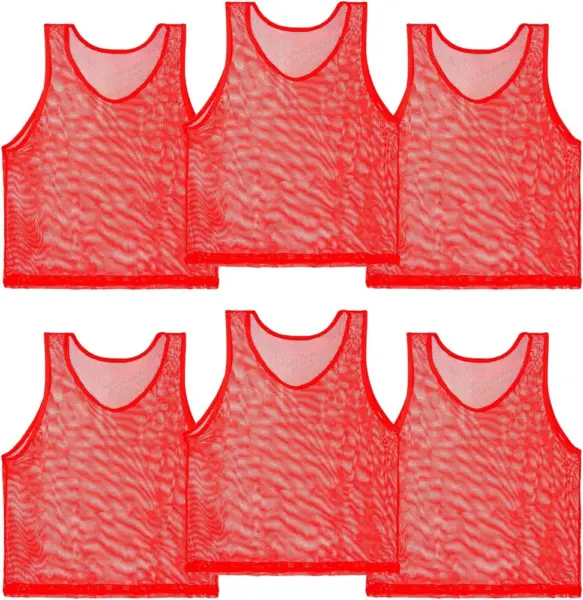
RAINFLOW Pinnies 6/12 Pack – Best Budget
Key Features
- Fit: Runs large
- Sizing: Teen and adult
- Set size: 6 or 12 vests
- Price: Budget
This is the cheapest set here, and for a rec team whose only job for a pinnie is telling two sides apart, we think that covers most of what matters. The colors are loud enough to read under gym lights, the mesh is light enough to forget, and the whole pack balls up small enough to live in the bottom of a gym bag between sessions.
Two practical notes from putting a set through practice. Wash them before the first session — new mesh has a factory smell that comes out in one cold cycle and not before. After that they behave: a set washed after every practice held its shape and its color, which is the whole lifespan question for a vest at this end of the market. The cut is generous, so this is a teen and adult set rather than one for the under-eights.
Pros
- The cheapest set in this group
- Bright colors that read across a gym
- Holds up through weekly washing
Cons
- Runs large on players under ten
Buy this one if the squad is teen or adult and the budget is thin — the cheapest set here, and generous enough through the shoulders to fill out older players.
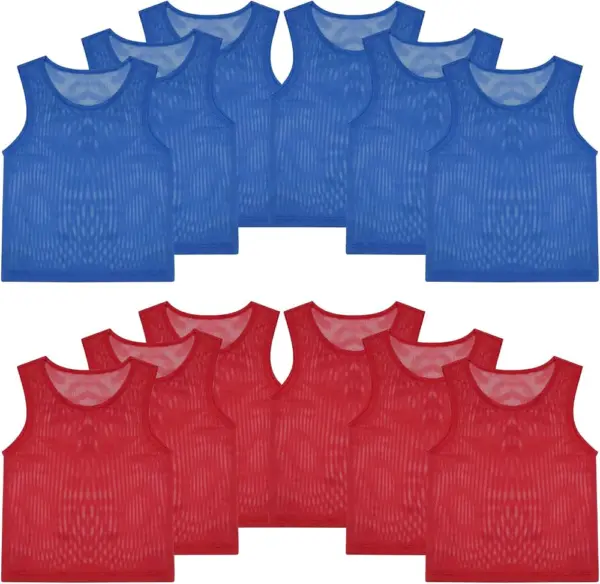
PEASUG Pinnies 6/12/24 – Best for Youngest Teams
Key Features
- Fit: Runs small
- Sizing: Youth and adult
- Set size: 6, 12, or 24 vests
- Price: Budget
A five-year-old in a pinnie cut for a ten-year-old looks like he’s wearing a tent, and the usual workaround is a knot at each shoulder or no vest at all for the smallest group. This set is cut for exactly those kids, and that’s the whole reason it’s here.
Kindergarten through third grade is the sweet spot. The vests go on over a t-shirt, the armholes land roughly where a small child’s arms actually are, and the two colors are different enough that a group of six-year-olds sorts itself into sides without a coach handing out bibs. For a U6 or U8 group, that’s the entire job description.
Our reservation is lifespan rather than fit. The edges and the stitching are the first things to look tired, and a set used twice a week can show loose threads before the season is out. For the youngest group, who will outgrow the set inside a year anyway, we’ll take that trade — just treat it as a season’s kit and not a hand-me-down for the next three.
Pros
- Genuinely small sizing for K-3 players
- Pack sizes from six to twenty-four
Cons
- Nothing here fits a player past third grade
Our pick for kindergarten through third grade, where most pinnies swallow the smallest players and this one finally fits them.
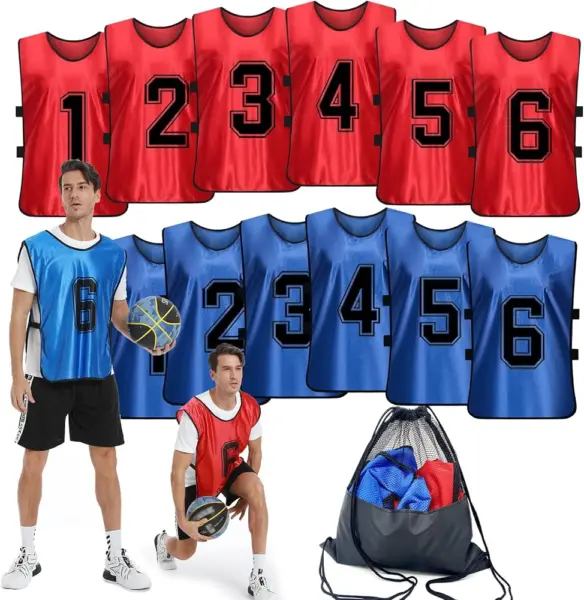
PULUOMASI Numbered Pinnies – Best Numbered Set
Key Features
- Set size: 12 vests
- Carry bag: Included
- Numbering: Front and back
- Price: Premium
Numbers change how a drill runs. Instead of shouting that the blue side is on offense, you call three numbers and the right kids move — and here the numbers are printed on both the front and the back, so a player can check his own without pulling the vest off in the middle of a possession.
The fit adjusts, which is how one set covers a U14 boys team and a group of adults in the same session; buy a step up from your t-shirt size, because these run small. The twelve arrive with a carry bag, and while a sack sounds like a throw-in, it’s the difference between a set that stays complete in a car trunk and one that sheds vests every week.
Treat the printing as the part to protect. Cold water and a line dry keep a numbered set numbered, and the same routine protects the shoulder seams, which are the second thing to watch on any pinnie. Do that and this is the set we reach for when a session is built around drills rather than a straight scrimmage.
Pros
- Numbers printed on both sides
- Adjustable fit spans youth to adult
- Carry bag keeps the set together
Cons
- Number printing can lift in a hot wash
Worth the premium if you coach by numbers: printed fronts and backs, an adjustable fit, and a bag that keeps twelve vests together.
Super Z Outlet 12 Pinnies – Best for Young Rec Squads
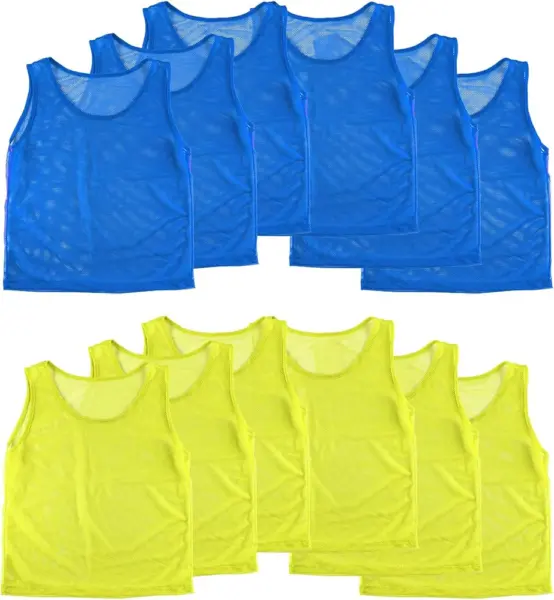
Key Features
- Fit: Runs small
- Sizing: Child, youth, teen
- Set size: 12 vests
- Price: Budget
These run small, and they don’t give. The mesh has almost no stretch to it, so a vest that measures right across the chest can still stop at the shoulders when a kid tries to pull it on over a t-shirt. Size up — we did, and the set went on without a fight — and size up twice if you’re outfitting anyone past sixth grade.
What the set does well is speed. Twelve vests come out of the bag and a scrimmage starts; they go on and come off fast enough that swapping sides between drills doesn’t eat the practice, and the colors are strong enough to see from the bleachers. That’s why we keep a set around for clinics and camps rather than for a travel squad that will notice the cut.
Pros
- Twelve vests for a small outlay
- Fast on and off between drills
- Colors visible from the bleachers
Cons
- Red reads closer to magenta in person
- Shoulder seams are the first wear point
A cheap twelve-pack that suits a young rec squad, provided you size up and don’t need a true red.
LTHYTY 12-Pack with Carry Bag – Best for Skill and Shooting Drills
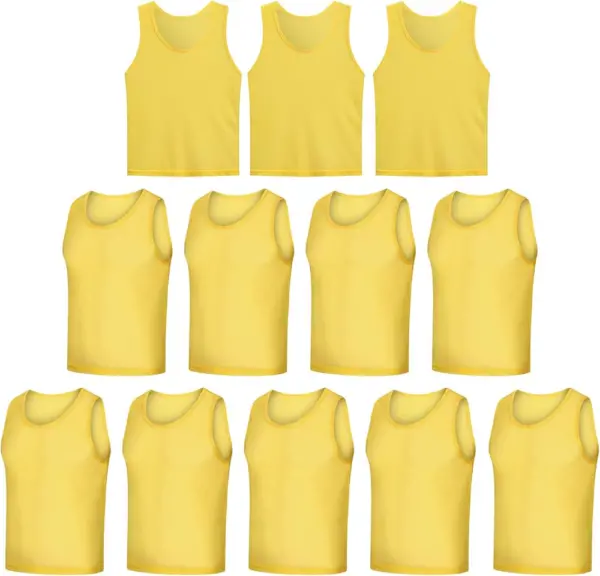
Key Features
- Set size: 12 vests
- Carry bag: Included
- Pack weight: 1.1 lb
- Price: Midrange
Twelve vests and a carry sack, in a package that weighs about as much as a filled water bottle. That’s the whole pitch, and for a coach who has been carrying loose pinnies in a laundry basket, the sack is the part that sells it.
The weight is worth dwelling on: a bit over a pound for the full set means each vest is a couple of ounces of mesh. In a hot gym that’s what you want — nothing to trap heat, nothing for a player to notice mid-drill — and it also tells you these are built to be light rather than armored.
Storage matters more than it sounds. A twelve-pack with a dedicated bag gets handed back complete at the end of practice, while loose sets quietly shed vests into the bottom of someone’s car over a season. Add a bright color and a plain, number-free design and you have a set that can live in the trunk without becoming a mess.
Our read is that this is the tidiest set here for a coach who wants everything in one bag: the vests are light, the bag closes, and nothing about the design gets in the way of a drill. It’s the one we’d hand out for shooting work and small-sided games, and the one we’d think twice about for a season of full-contact rebounding practice.
Pros
- Carry bag keeps twelve vests together
- Exceptionally light set to carry and wear
- Packs down small between sessions
Cons
Twelve light vests and a carry sack that keeps the set together — the pick when your kit lives in the car and practice is mostly drills.
VOGRYE Reversible Pinnies – Switching Sides Fast
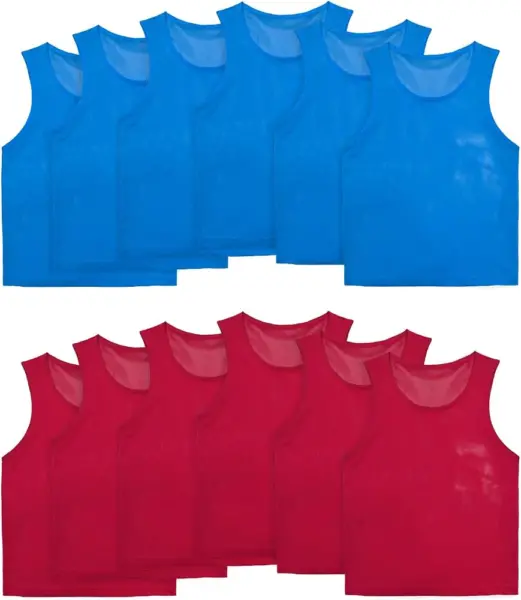
Key Features
- Sizing: Youth
- Set size: 12 or 24 vests
- Reversible: Two colors
- Price: Midrange
Reversible pinnies solve a specific annoyance: at the end of a scrimmage half the kids are in the wrong color, and the coach spends the next two minutes refereeing a vest exchange instead of running the drill. Flip these inside out and the sides change in about three seconds, which keeps a practice moving.
Our take is that the flip earns its place in scrimmage-heavy sessions and adds little to a drill night, where you’re splitting the same sides over and over anyway. If your practices are mostly games — small-sided, half-court, end-of-session — this is the design you want.
The sizing is where it bites. These run snug and there’s very little stretch to bail you out, so a set bought for a second- or fourth-grade rec team works nicely while a ten-and-under travel squad will find them tight through the chest. Order a size up, or keep this set for the younger group; the colors stay bright and the stains and gym smell come out in the wash.
Pros
- Two colors in a single vest
- Fast side changes mid-scrimmage
- Washes clean of stains and odor
Cons
- Thin fabric with very little stretch
Flip them inside out and the sides change — worth it for scrimmage-heavy practices, as long as your squad is on the younger side.
Sintege 12 Pc Pinnies – Best for Smaller Mixed Squads
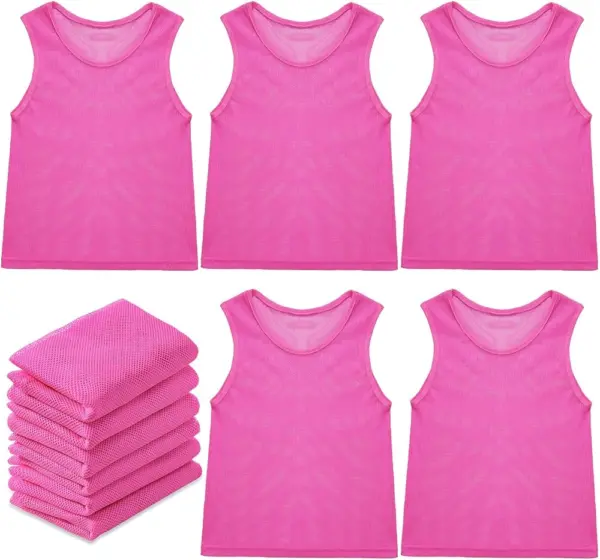
Key Features
- Sizing: Youth and adult
- Set size: 12 vests
- Pack weight: 1.32 lb
- Price: Midrange
Set this against our top pick and the difference is the cut rather than the count: twelve vests either way, but this set runs smaller through the shoulders and chest, and the sizing gives you less room to work with when your roster is mixed. Priced at the same level, that’s the whole comparison.
The colors are the strongest argument for it — bright, including a pink that reads clearly from the sideline, and they come through the wash without fraying. A set that looks like it went into the machine rather than through it is worth something by midseason.
The whole thing packs into a box smaller than a shoebox and weighs a bit over a pound, which matters if your kit lives in a car between sessions. Twelve mesh vests that compress that far are easy to keep track of, and easy to hand back complete at the end of practice.
Sizing decides the purchase. For a team of smaller players this is a bright, tidy set that washes well; for a mixed roster with a couple of big forwards, the shoulders are where it either fits or doesn’t, and ordering up only buys so much. Check your biggest player first, and if the answer is close, spend the money on the top pick instead.
Pros
- Bright colors, including a clear pink
- Washes without fraying
- Compact pack that stores small
Cons
- Stitching can come undone within a season
A bright, well-made twelve-pack that suits smaller squads; if your roster has size on it, our top pick fits better.
How We Tested Basketball Pinnies Through a Full Season
We started with the pinnies coaches actually reorder — the ones that turn up in team-supply catalogs and school equipment orders year after year — then filtered by price per unit, mesh weight, the spread between youth and adult sizes, and whether numbers came included. That left 14 that we bought ourselves and handed out for a season of real practices.
Each one got pulled over a t-shirt, over a hoodie, and over a padded shooting shirt, on players ranging from a 5’2" guard to a 6’3" forward, plus a group of 9- and 10-year-olds at Saturday clinics. We noted where the armholes gaped, whether the shoulders slid off during defensive slides, and whether the youth sizes matched their labels — several ran a full size small.
Everything went home in the laundry after every session, so some pinnies saw two wash cycles a week for four months. We checked shoulder seams after each wash, watched for mesh runs and stretched-out necklines, and by midseason counted how many numbers were still legible from the baseline; screened numbers cracked and peeled, stitched ones mostly held.
For color, we split into light and dark groups and looked at them from across the gym under game lighting, then washed a red and a white together to see what bled. Value came down to cost per player for the season: a cheaper pinny that had to be replaced in week six cost more than the one that didn’t.
How to Choose Basketball Practice Pinnies
A pinnie is a mesh bag with armholes, so the decision comes down to three things: how many you need, whether the cut will go over the players you actually have, and whether the seams survive a season of practice.
Count the squad before you count the colors
Twelve is the number most teams settle on: ten for a full-court scrimmage plus two spares for the player who forgot his or the one whose vest is still damp. Six covers small-sided drills and half-court work; twenty-four only earns its place if you’re running two groups at once or outfitting a whole program.
We like a pack that covers your roster plus two rather than one that fits it exactly, and we buy the whole thing in one colorway. Colors from different makers rarely match, and a set that’s half one shade and half another undoes the reason you bought it.
Sizing is where a pinnie purchase goes wrong
The size printed on the bag and the size that comes out of it are not always the same thing. A pullover pinnie has no elastic and no fastening, so there’s nothing to take up slack across the shoulders: a vest that’s snug on the hanger is snug on the player, and one cut for a third grader will not stretch to fit a sixth grader.
Try one vest on your biggest player before you hand out the rest, and when you’re between sizes take the larger. A slightly big pinnie still goes on over a hoodie in a cold gym; a tight one doesn’t go on at all, and that kid spends practice on the sideline.
Mesh weight and the shoulder seam
Every vest in this group is mesh; what changes is how much fabric you get. A twelve-pack that ships at around a pound is a whisper of cloth — lovely in a hot gym in August, less reassuring when someone grabs a fistful of it at the rim. Heavier mesh holds its shape and traps more heat, which is the trade you’re making.
Whichever you buy, the shoulder seam is the wear point, and the dryer does more damage there than any drill. Cold wash, hang dry, and keep the vests away from the hook-and-loop straps on gym bags, which snag mesh and pull a loose thread into a run.
Numbers, reversibility, and the bag
If you coach with numbers — three, seven and eleven, you’re on — a numbered set earns its extra cost, because printing on the front and the back lets a player check his own number without taking the vest off. Reversible vests solve a different problem: flip them and the sides change in seconds, which is worth it for scrimmage-heavy practices and less so for drills.
A carry bag looks like a throw-in and turns out to be the thing that keeps twelve vests together instead of nine. If your kit lives in a car between sessions, it’s worth choosing a set that comes with one.
Frequently Asked Questions
What’s the difference between a pinnie, a scrimmage vest, and a practice jersey?
Nothing, for the first two. Pinnie, penny, bib and scrimmage vest all mean the same pullover mesh top, and the name changes with the sport and the region. A practice jersey usually means a heavier jersey cut that a team would also wear in a game.
If you only need to split sides at practice, buy the lightest mesh vest that fits your roster. If your league requires matching numbered jerseys for games, a pinnie won’t satisfy that.
Can I add numbers to a plain set myself?
You can, and it rarely lasts a season. Marker fades after a couple of washes, and iron-on transfers lift at the corners once the mesh starts flexing in a drill. Factory printing sits in the fabric rather than on top of it.
If numbering is part of how you coach, buy it built in. If you’re numbering a set you already own, put the number on the back only and hand-wash to buy yourself time.
Do I need pinnies, or can we just play shirts and skins?
Shirts and skins works in a small group that’s comfortable with it, and costs nothing. It stops working when half the squad arrives in gray, when the gym is cold, or when you’re coaching kids old enough to be self-conscious about it.
As a rule of thumb, a group of eight or fewer can get by without them; anything bigger, or any mixed-age group, moves faster with a set of twelve.
Final Verdict
We hand most coaches the LITEMESH set: light enough that players forget they have it on, sized across a youth roster, and washable enough that a twice-weekly practice doesn’t leave the bag smelling like a locker room. Buy twelve for one team and twenty-four only if you’re running two groups.
Two situations change the answer. If your squad is still in kindergarten through third grade, PEASUG’s smaller cut fits them where everything else swims, and if the budget is tight and the players are teenagers or adults, RAINFLOW’s generous cut covers them for the least money here.