
This post contains affiliate links. We may earn a small commission when you buy through our links — at no extra cost to you.
A portable hoop rolls away in a gust, tips if someone hangs on the rim, and eats up half the driveway so you have to move it before anyone can park. A wall-mounted one just sits there at the same height, ready the second somebody walks outside with a ball. What it won’t do is forgive a sloppy install. I’ve watched a rim fold sideways off a bracket anchored with the wrong bolts, and no clever height mechanism fixes that afterward. The right hoop takes an afternoon to mount and then disappears into the background for years.
We hung 10 wall-mounted hoops over nine months — on brick, on wood siding, and on a bare stud wall in a garage — and the differences came down to the bracket, not the backboard. Here’s what I wish someone had told me before my first install: the number of height settings matters far less than how you change them. A hoop that needs two people and a ladder to drop from ten feet to eight will stay at ten feet forever, and the kid who was supposed to grow into it won’t touch it. The picks below are the ones that stayed solid, stayed quiet, and actually got used.
Our Top Picks
The Best Wall Mounted Basketball Hoop, Reviewed
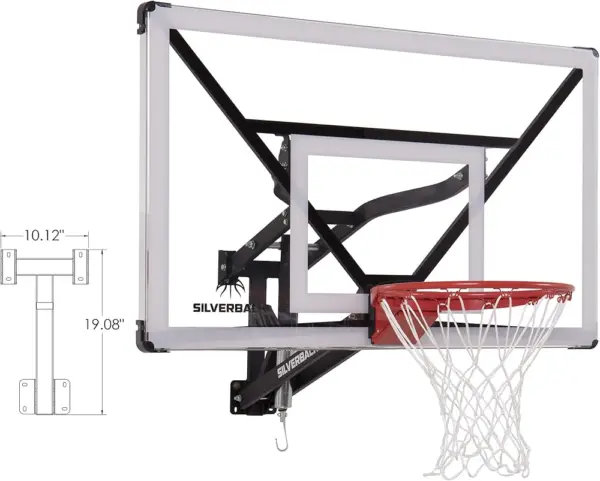
Silverback NXT 54-Inch – Best Overall
Key Features
- Weight: 76.3 lb
- Backboard: 54 x 33 inches, Infinity Edge
- Rim height: 7.5 to 10 feet
- Wall standoff: 5 inches
- Price: Premium
Ten feet at the top, 7.5 at the bottom, and an all-steel adjuster that moves between them: that range is the reason this one leads the group. A single backboard serves a 12-year-old practicing dunks and an adult pickup game twenty minutes later, and the 54 x 33-inch Infinity Edge board with its folded sides looks like a court fixture bolted to the house rather than a toy screwed to the siding.
We think it’s the best fit here for a driveway or garage wall that has to keep a whole family busy for years. The powder-coated steel and the five-year limited warranty carry that argument, and the board stands 5 inches off the wall, so it stays clear of a parked car or a walkway. What the box does not carry is mounting hardware: no bolts, no anchors. Plan a hardware-store run and match the fasteners to your wall before anyone takes a shot.
Installation is the part to respect. Seventy-six pounds of backboard, arm, and rim want two people and a ladder, and the mounting points need structural framing behind them. The directions are thorough but the kind you read twice with a level in your hand. Once it is up and level, it plays like a permanent installation rather than a seasonal one, and a season of weather does not change that.
The adjustable arm has one honest cost: raise the board to full height and a hard shot can set the backboard moving a little. At 7.5 feet it is steady, and that is where a young family spends most of its evenings anyway.
Pros
- Adjusts from 7.5 to 10 feet for any age
- 54-inch Infinity Edge board looks like a court fixture
- Powder-coated steel with a five-year limited warranty
- Indoor or outdoor installation, 5 inches off the wall
Cons
- Backboard can wobble when raised to full height
Our pick for a house or garage wall: a 54-inch board that drops from 10 feet to 7.5, so kids and adults can share one rim.
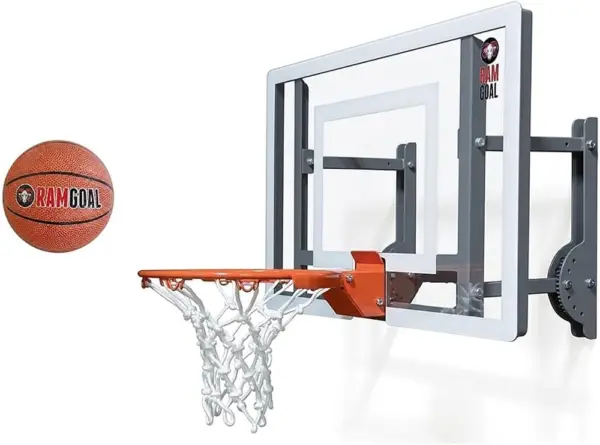
RAMgoal Wall Mounted Mini – Best for Indoor Dunking
Key Features
- Rim: 10 inches, breakaway
- Backboard: 24 inches, shatter resistant
- Rim height: 48 to 108 inches
- Included ball: 5-inch mini
- Price: Midrange
Thirteen and a half pounds, a 24-inch shatter-resistant board, and a bracket that goes into studs: this is the mini hoop to buy when the wall is inside the house and somebody is going to dunk on it. The rim is spring-loaded and breakaway, and the height runs from 48 inches to 108, low enough for a five-year-old’s set shot and high enough that a teenager gets a real release.
The steel in the mount is what separates it from the door hoops in this roundup. Those hang off a door frame and work loose; this one is fastened to the structure, and the difference shows the first time someone hangs on the rim. A 5-inch synthetic leather ball comes in the box, so the hoop is playable the hour it goes up.
Put it in a garage, a basement, or on a teenager’s bedroom wall. The spring rim gives under a dunk and snaps back, which is the difference between a hoop that survives a 14-year-old and one that ends up bent, and the height adjustment is quick enough that siblings of different ages can share it without an argument.
The price is the sticking point. This is the priciest mini hoop in the group, and if all you want is a target for a seven-year-old’s set shots, the cheaper set here does that job perfectly well. What the money buys is a bracket that expects to be hung on, and in a house with a kid who dunks daily, that is the whole point.
Pros
- Steel bracket mounts directly into wall studs
- Spring-loaded breakaway rim survives dunks
- Adjusts from 48 to 108 inches
- 5-inch mini ball included
Cons
- Indoor only, not built for exterior walls
Hang it indoors if dunking is the point: a stud-mounted steel bracket and a breakaway rim that takes the abuse a mini hoop usually doesn’t.
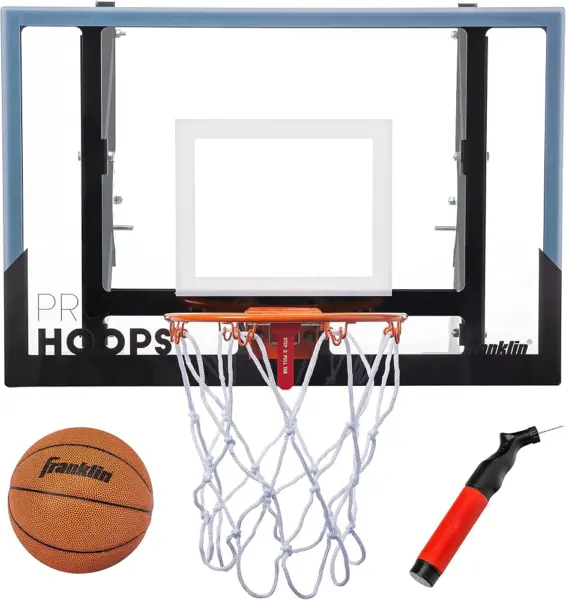
Franklin Pro Hoops XL – Best for Game Rooms
Key Features
- Rim: 9.5 inches, fold-away
- Weight: 13.9 lb
- Hardware: Steel bolts and wall anchors included
- Backboard: 23.5 x 16 inches
- Price: Midrange
The rim folds up and out of the way when the game ends, and in a room that has to be a guest room, an office, or a bedroom the rest of the time, that hinge does more for daily life than any specification on the box.
We like it best for a game room or a garage bay. The 23.5 x 16-inch shatter-resistant board, 9.5-inch metal rim, and eight-loop net are scaled for the 5-inch ball it ships with, and the height adjusts, so a 10-year-old and a 15-year-old both shoot at something that feels right. Steel bolts and plastic wall anchors come in the box, one fewer errand than the full-size pick costs you.
Two things to check before the drill comes out. The wall brackets sit 15 inches apart, which lines up with nothing on a wall framed at 16-inch centers, so plan a backer board across two studs and mount to that instead of trusting anchors in drywall. And the board is loud: a hard shot rings off it, which makes a wall shared with someone sleeping the wrong wall.
The fold-away hinge carries the load of every dunk, so keep half an eye on it if your players hang on the rim. Otherwise this is a sensible indoor hoop, and the one here that disappears most completely when nobody is playing.
Pros
- Fold-away rim clears the room between games
- Steel hardware and wall anchors included
- Height adjusts for kids and teens
Cons
- Rim can bend under repeated hard dunks
- Backboard rings loudly in a small room
For an indoor wall that has to go back to being a room, the fold-away rim and included steel hardware make this the easy choice.
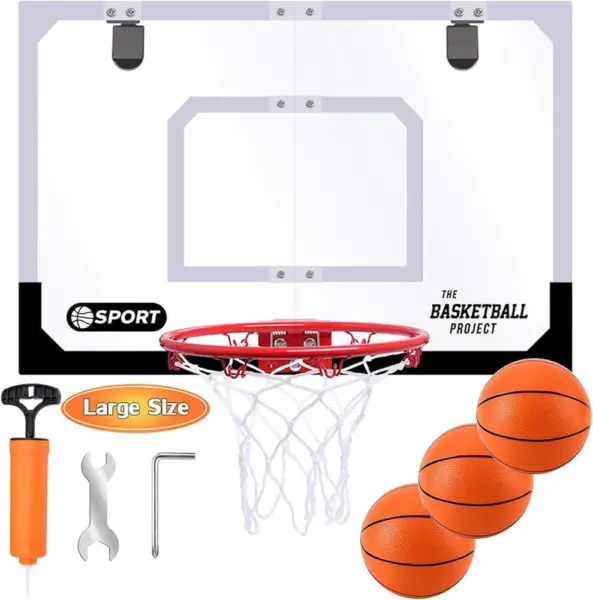
TNELTUEB 24-Inch Mini Hoop – Kids’ First Wall Hoop
Key Features
- Balls: Three 7-inch rubber
- Weight: 4 lb
- Included: Pump, screws, wrench, screwdriver
- Backboard: 24 x 16 inches polycarbonate
- Price: Budget
The backboard arrives in two halves and you bolt them together with three spacers before it ever touches the wall, a strange first ten minutes that produces a genuinely rigid 24-inch board once the screws are snug.
What comes in the box is generous for a set at this end of the group: a clear polycarbonate board, a steel rim and net, three 7-inch rubber balls, a pump, plus the screws, wrench, and screwdriver. We noted that the balls run larger than the 5-inch minis most sets ship with, which suits the wide board but feels big in a small hand.
For a bedroom or basement wall with several kids in line, it is the most hoop per dollar here: the mounting hardware is included, the board is wide enough that bank shots actually work, and nothing else on this page asks less of a wall.
The rough edges are real. Fasteners turn up mismatched or missing often enough that you should lay every screw out and match it to the instructions before drilling; a mid-install run to the hardware store is the kind of errand that sours an afternoon. And this is a kids’ hoop rather than a dunking rig, so treat the rim as a target instead of a handle and it holds up better.
Pros
- Large 24-inch polycarbonate backboard
- Three balls, pump, and mounting tools included
- Cheapest complete wall-mount set here
Cons
- Screw sizes can be mismatched or missing
- 7-inch balls are big for small hands
The best-value mini set here if the hoop is going on a kids’ wall: big backboard, all the hardware, three balls in the box.
How We Hung, Shot On, and Stress-Tested 10 Wall-Mounted Hoops
We started with a list of roughly 40 wall-mounted hoops sold by the major sporting goods retailers and home improvement stores, then cut anything that shipped without mounting hardware, anything with a backboard smaller than 44 inches, and anything whose height could only be set once at installation. That left 10 hoops, which we mounted and lived with for nine months.
Installation was the first real test. Two of us timed each assembly from opening the box to a ball going through the net, and we noted whether the instructions actually named the wall type and the drill bit. We mounted on brick, on wood siding over studs, and on a bare garage wall, paying attention to whether the included anchors matched the surface — several sets didn’t — and whether the bracket could still be leveled after the bolts were torqued down.
Then we just played. Kids shot before school, adults ran one-on-one after work, and a couple of us hung on the rim harder than we should have. We adjusted heights alone to see whether adjustability was real or theoretical, watched for rim flex and backboard shake after a month of use, and checked welds, seams, and rim finish for rust and hairline cracks as the seasons turned.
Noise got its own check: one tester stood in the kitchen with the door shut while a ball came off the backboard, just to hear how much carried inside. We also weighed the price of each hoop against backboard size, the quality of the hardware in the box, and how many parts could work loose over a season — for this category, value is mostly a question of how much hoop you get for the money.
How to Choose a Wall Mounted Basketball Hoop
The wall is the piece of equipment nobody shops for, and it narrows the choice faster than any feature printed on the box.
Find the Framing Before You Shop
Every wall-mounted hoop here hangs from two or more holes, and those holes have to reach wood or masonry rather than drywall. Run a stud finder across the spot at rim height and mark the centers. If the bracket holes miss the framing, bolt a pressure-treated backer board across two studs and mount to that. Spacing matters too: the Franklin’s brackets sit 15 inches apart, which is awkward against studs at 16-inch centers, while the Silverback’s plate wants a wide, flat structural surface. Bolts are frequently not in the box, so budget that hardware trip before installation day.
Size the Board to the Space and the Rim Height to the Players
A 54-inch backboard needs a driveway or garage wall with room around it; a 24-inch mini board is built for a bedroom wall. The number we care about more is rim height. Regulation is 10 feet, and a fixed rim at that height leaves out everyone under about 12. Adjustable models fix it: the Silverback runs 7.5 to 10 feet, the RAMgoal 48 to 108 inches. If kids will shoot on it, buy the range rather than the biggest board — you will use the adjustment every year and the extra width only sometimes.
Rims, Dunks, and What the Wall Absorbs
A spring-loaded breakaway rim gives when someone hangs on it and snaps back; a fixed rim passes that load into the backboard, the arm, and the bracket. If dunking is part of the plan, take the breakaway rim and the stud-mounted bracket together, because one without the other just relocates the failure. Where the room is shared, a fold-away rim like the Franklin’s clears the space between sessions. Expect a little movement from any adjustable arm raised to full height; that flex is the mechanism working, not a defect.
Indoor and Outdoor Are Different Purchases
We treat indoor and outdoor hoops as separate products because that is what the materials say. Outdoor installations live with sun, rain, and temperature swings, and the full-size pick here is built for it with powder-coated steel and a folded-edge board. Most minis are indoor furniture: the RAMgoal is indoor only, and a thin polycarbonate board left in the weather ages badly. Keep an indoor hoop inside or under a roof where rain cannot reach it, and check the fasteners once a season either way.
Frequently Asked Questions
Is a wall-mounted hoop better than an over-the-door one?
They solve different problems. An over-the-door hoop hangs on a door frame, needs no tools, and suits a bedroom or an office, but it cannot carry real weight, so dunking wrecks it and the door takes the beating. A wall mount screws into framing and plays like a permanent installation. If you rent and cannot drill, stay with the door; if you own the wall and someone will hang on the rim, drill.
How much clear space do I need in front of the hoop?
A free-throw line sits 15 feet from the backboard, so give yourself at least that much floor or pavement if you want to shoot anything resembling a game. Add the standoff as well: the Silverback’s board sits 5 inches off the wall. A driveway 20 feet deep works comfortably; a hallway does not, which is why mini hoops belong on a wall with a bed or a sofa behind the shooter.
What size ball do mini wall hoops use?
Mini hoops run on 5- or 7-inch rubber balls: the RAMgoal ships a 5-inch synthetic leather ball, and the TNELTUEB set comes with three 7-inch balls. Match replacements to whatever came in the box, since a regulation ball is close to the full width of a mini rim and will not drop through cleanly. Order a spare with the hoop; the ball is the first thing to get lost.
Final Verdict
If the hoop is going on the outside of a house or garage, buy the Silverback NXT. The 54-inch board plays like a court installation, and the 7.5-to-10-foot range keeps it useful as the shortest player in the house grows. For an indoor wall where kids dunk, the RAMgoal is the better spend: less backboard, far more bracket. And if the hoop has to disappear between games, the Franklin’s fold-away rim is the whole reason to choose it.