
This post contains affiliate links. We may earn a small commission when you buy through our links — at no extra cost to you.
The worst thing about basketball goggles isn’t the look — it’s the moment the lens fogs over while you’re tracking a pass. I’ve had a pair turn into a sauna during a fourth-quarter run, and I’ve seen a strap give out mid-box-out. Goggles exist to protect the eye an elbow is heading for, and the good ones do it without you thinking about them at all. What you’re really paying for is a clear lens, a frame that holds its shape when it takes a hit, and a strap that stays where you put it.
Over the past four months, my team and I ran 12 pairs through pickup games, rec league nights, and plenty of sweaty driveway sessions. The pattern showed up fast: the pairs that fogged had poor airflow, and the ones that slipped had straps that couldn’t be snugged down properly. Fit matters more than most shoppers expect, too — a frame that sits close to the cheekbones quietly cuts your peripheral view. The picks below are the ones we’d actually wear into a game.
Our Top Picks


The Best Basketball Goggles, Reviewed
8068 Basketball Goggles – Best Overall
Key Features
- Model: 8068
- Case included: Yes
- Intended wearer: Unisex adult
- Replaceable lenses: Yes
- Price: Midrange
The feature that decided this one for us is the lens: it comes out. Pop it and you’re holding a framed, nose-guarded shape that still sits between a ball and your eye, so a scratched lens stops being a reason to buy a whole new pair. The hard case it ships with is the other half of that — ours lives in a gym bag, and it’s why the lenses still look new.
Coverage is generous where it counts. The frame wraps past the temple and the nose guard holds the lens off your cheekbone, so there’s no soft gap at the outside corner for a finger or an elbow to find. It’s a unisex adult fit, and on the face it reads as sports gear rather than a medical device — which matters more than it should to a teenager who has been told to wear goggles.
Fog is what usually ends a goggle’s career mid-season, and this one stays clear through a long stretch of play. When it does mist over in a cold gym, it clears once you start moving. The weak point is the bridge piece: it’s a separate part and it can work loose, so seat it before tip-off and check it again if the frame has been rattling around a bag all week.
Against the rest of this group, it’s the only pair that combines a replaceable lens, a case, and side coverage this complete. The exception is a young player who needs a youth frame — this is an adult fit, and the BLUE CUT further down is the one to look at instead.
Pros
- Replaceable lens extends the life of the frame
- Side coverage reaches past the temple
- Hard case included
- Stays clear during play
Cons
- Bridge piece can work loose
Our pick for most players: it covers the outside corner of the eye, stays clear through a long run, and takes a new lens when the old one scratches.
Unique Super Specs – Best Budget
Key Features
- Frame: Wrap-around, no arms
- Retention: Wide adjustable strap
- Sports listed: Squash and racquet sports
- Price: Budget
The cheapest pair here gets there by removing parts rather than cheapening them. There are no arms at all: the frame wraps your face and a wide strap holds it there, so there’s nothing to snap, nothing digging into your temples under a headband, and nothing to fiddle with mid-game except the strap itself.
That design is why we like it for schools and rec leagues. The wrap keeps your peripheral vision, so you can track a cutter without turning your head, and it stays put through a hard game — which is more than a lot of goggles manage.
Two things to know going in. It fogs more readily than anything else in this group; once the view goes soft in a warm gym, you’re stopping to clear it. And the side pieces are rigid, so a wider face feels them pressing after twenty minutes. Neither is a dealbreaker at this price, but both are real.
For a program outfitting a roster, the arithmetic works: two of these cost less than the priciest pair here. Buy it as a first goggle, a spare, or a club set, and keep a microfiber in your pocket.
Pros
- No arms to snap under a headband
- Wide strap holds through hard play
- Wrap keeps peripheral vision
Cons
- Fogs quickly in a warm gym
- Rigid sides press on a wide face
For a rec-league or school player who needs eye cover and nothing fancy, this is the pair we buy by the handful.
UKNOW Sports Goggles – Best for a Low Nose Bridge
Key Features
- Case included: Yes
- UV protection: Yes
- Intended wearer: Unisex adult
- Price: Midrange
The nose piece on the UKNOW is unusually tall, and that bit of geometry is the reason it’s on this list. It holds the frame off your cheeks instead of resting on them, so air keeps moving behind the lens and you avoid the sweaty suction that makes other goggles miserable by the second quarter.
On a flatter nose bridge, where most goggles slide, it sits where you put it. The sides flex to clear a wider temple, the strap holds through a full-court run, and it ships with a hard case — at this price, that last one is a genuine surprise.
We came away thinking of it as the fit-first pick. Nothing on it needs adjusting mid-game, and after an hour it’s easy to forget you’re wearing it, which is the highest compliment a goggle can get. Vision through the middle of the lens is clean.
The edges blur a little, though, and the frame crops a sliver of your view to the side — enough that we noticed it for the first few minutes. For a low bridge, or a face that has never found a goggle that stays put, it’s the one to try first.
Pros
- Tall nose piece keeps the frame off your cheeks
- Flexible sides clear a wider temple
- Hard case included
Cons
- Edge blur and a cropped side view
If your goggles always slide down your nose, start here: the tall nose piece holds the frame off your cheeks and keeps it where you put it.
BLUE CUT Kids Goggles – Best for Young Players
Key Features
- Case included: Yes
- Intended wearer: Youth
- Prescription lenses: Replaceable
- Price: Midrange
The pitch is simple: a goggle cut for a child’s face, with a frame that takes a prescription lens. If you’ve spent an afternoon watching adult goggles slide down a kid’s nose, you already know why that matters.
On a small head the difference is obvious. The strap pulls the frame in rather than clamping it, the silicone along the sides sits flat against the temple, and it comes with a case and accessories that survive a school bag. It also doesn’t look like lab equipment, which is roughly half the battle.
We recommend it for young players without much hesitation, with one caveat. The plastic around the nose is firm, and on a small face it presses. Fit it before the season starts, not on the way to the first game — pressure on the bridge is the usual reason a kid quietly stops wearing a goggle.
The other thing to keep in mind is the frame itself, which can crack when it’s dropped or kicked across a gym floor. The case helps, and so does the fact that a replacement frame costs a fraction of an optician-built prescription pair.
Pros
- Youth sizing adult goggles can’t match
- Takes a prescription lens
- Case and accessories included
Cons
- Firm nose padding presses on small faces
- Frame can crack when dropped
For a child, this is the pair we recommend: genuine youth sizing, a frame that takes a prescription lens, and a case that survives a school bag.
Andux Sports Glasses – Everyday Practice

Key Features
- Model: LQYJ-01
- Retention: Adjustable strap
- Sports listed: Basketball and soccer
- Price: Midrange
Close to our top pick on price and close to it on coverage, this is the pair we wanted to like more than we did. The frame wraps well, the strap adjusts, and the lens sits far enough forward that sweat runs down your face instead of into your eye. What it can’t do is fit everyone.
The nose and brow pad is the deciding part, and it’s molded as a single piece. It touches the bridge of your nose and your forehead at the same time, so on a face it doesn’t match you get two pressure points doing the same job. Strap adjustment won’t fix that — the frame either agrees with your face or it doesn’t.
Sizing runs small as well. A smaller face will find it snug and secure; a broader one will find it tight, and the top edge sits close enough to the brow that looking up for a rebound is where you notice it.
It undercuts the 8068 while giving you a similar wrap, and the wide lens genuinely does keep sweat out of your eyes. Whether that’s a bargain or a return depends entirely on the shape of your face — which is a strange thing to say about goggles, and the truest thing about this pair.
Pros
- Wide lens keeps sweat out of the eyes
- Adjustable strap with a secure wrap
- Costs less than the top pick
Cons
- One-piece pad presses nose and brow
- Sizing runs small
Buy it only if the nose and brow pad agrees with your face — when it does, you get the top pick’s wrap for less.
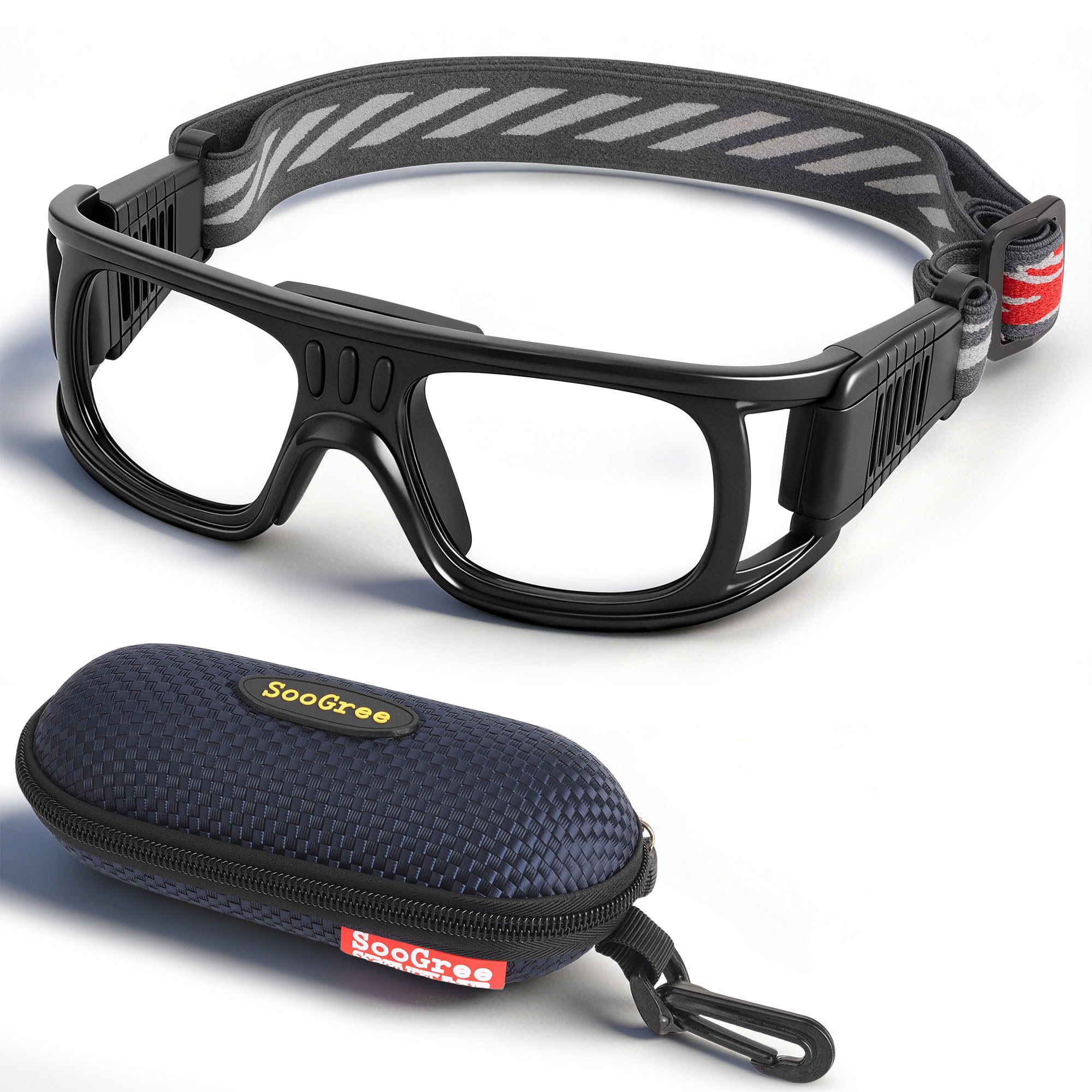
SooGree Sport Glasses – Multi-Sport Play

Key Features
- Anti-fog: Yes
- Sports listed: Basketball and football
- Intended wearer: Men, women, and teens
- Price: Premium
Anti-fog and shock-collision are the two things SooGree leads with, and it asks more money than anything else here for them. Both are worth having in a warm gym where the ball moves fast: a lens that clouds is worse than no lens, because you keep playing through it.
Our hesitation is fit. One unisex shape listed for men, women, and teens is a lot of faces for a single frame, with no second width to fall back on. Measure across your temples against a pair of glasses that already fits you, and treat that number as the one thing you can check before ordering.
Set against the 8068, which costs less, you’re trading a replaceable lens, a case, and full side coverage for the anti-fog claim and the shape. That’s a fair trade only if the shape suits you.
Pros
- Anti-fog lens listed for warm gyms
- Sold for basketball and football
Cons
- One shape for men, women, and teens
- Priciest pair in this group
It’s the priciest pair here, and the anti-fog and shock claims are the reason to consider it — provided the single unisex shape suits your face.
How We Tested Basketball Goggles
We started by pulling together every pair we could find with credible eye-protection claims, then filtered by frame material, lens shape, strap type, and whether the sizing ran to both adult and youth fits. Price was a factor, since we wanted a spread of options rather than only the most expensive pairs, and we dropped anything whose lens flexed under thumb pressure or whose strap felt flimsy straight out of the box. That left 12 pairs.
Testing ran four months, mostly indoors on gym floors but also outdoors on driveways. Each pair got worn during pickup runs, rec league games, and individual shooting workouts, and we handed pairs to players with different face shapes and to a couple of teenagers at youth practice, because fit shifts a lot with head size.
The most useful test was simple: put them on, play until you sweat, and watch what happens to the lens. We noted whether fog crept in at the edges or covered the whole lens, how long it took to clear, and whether wiping made it worse. We also tracked how much of the court we could see without turning our heads — a few frames had side pieces that hid a cutter coming from the wing. Comfort got checked at the 30-minute mark, when we asked wearers about pressure at the temples and across the nose. Durability was tested the hard way: goggles went into gym bags without cases, got dropped on hardwood, and took a few accidental elbows, after which we looked for cracks in the frame and stretch in the strap. Value came down to whether a pair still felt solid at the end of four months.
How to Choose Basketball Goggles
The most useful thing to know about basketball goggles is that fog, not impact, is what makes most players take them off.
Fog decides more games than impact does
A clouded lens is the one you stop wearing, and most fog comes from the space between your face and the frame. A goggle that sits flat against the cheekbone traps warm, wet air; one with a nose guard that stands the lens off your skin lets it escape. That is the trade you make when you choose a bigger, closer-fitting lens. If you fog everything, favor standoff over maximum coverage, and treat an anti-fog coating as help rather than a guarantee.
Fit is decided at the nose bridge
Straps adjust tension; they don’t change shape. Whether a goggle works comes down to the bridge and the width across your temples, which is why one pair can feel invisible on one player and unbearable on the next. A molded pad that touches nose and brow at once is the usual culprit, because you get two pressure points instead of one. Compare a pair’s listed wearer and shape to glasses you already own, and if you have a low bridge, look for a tall nose piece like the one on the UKNOW.
Coverage against peripheral vision
Every millimeter of lens that wraps further around the eye is protection you’re glad of when an elbow arrives from the side, and vision you give up when you’re tracking a pass. Basketball rewards the wrap. Racquet sports, where the ball mostly comes from in front, don’t need it as badly. Look at what the frame does past the temple and under the eye: the Unique Super Specs sit close under the eye, while the 8068 reaches further around the corner.
Replaceable lenses and prescriptions
The lens is the part that scratches, and a frame whose lens comes out outlives one whose doesn’t. That matters twice if you need correction: a goggle with a replaceable lens can be fitted with a prescription one by an optician, while a molded single-piece lens can’t. Check for that before you order, and have any prescription lens cut and seated professionally rather than trimming one yourself.
Buying for a child
An adult frame on a child’s head slides, presses, or both, and the usual result is a goggle that spends the season at the bottom of a bag. Look for a youth size, a strap that pulls the frame in rather than clamping it, and padding that doesn’t turn hard against a small nose. Fit it before the season, then check the bridge after ten minutes of wear — that’s when the complaints start, not immediately.
Frequently Asked Questions
Do basketball goggles actually prevent eye injuries?
They stop the things that cause most court injuries — a finger, an elbow, the ball arriving flat — because the lens and frame take the contact instead of the eye. They don’t make your face invulnerable, and a scratched or cracked lens protects far less than an intact one. Replace any damaged lens, and wear the goggles in practice, not just in games.
Can I use the same pair for other sports?
Most of the goggles here are listed for several. The 8068 covers basketball, racquetball, and soccer; the Andux covers basketball and soccer. Fit and coverage matter more than the label, though. If you play basketball as well as racquet sports, favor side coverage over a low profile — that’s the difference that carries between them.
How do I clean them without ruining the anti-fog?
Rinse with lukewarm water and dab dry with a clean microfiber cloth. Never wipe the inside of the lens with a jersey, a paper towel, or your fingers — that strips an anti-fog coating, and once it’s gone the fog returns for good. Mild soap and water on the frame is fine. Keep solvents and hot water away from the lens.
How tight should the strap be?
Snug enough that the frame doesn’t shift when you shake your head firmly, loose enough that you can slide a finger under the strap at your temple. Tighter isn’t safer: it pushes the frame into your cheeks, which traps warm air and fogs the lens faster. Set it before warmups and leave it alone.
Final Verdict
The 8068 is the pair we point most players to. Its lens comes out, its coverage reaches past the temple, and it arrives in a case that keeps both usable — enough to edge out a budget pick that fogs and a fit-first pick whose edges blur.
If money is the binding constraint, take the Unique Super Specs and keep a cloth in your pocket. If the wearer is a child, skip both and buy the BLUE CUT.