
This post contains affiliate links. We may earn a small commission when you buy through our links — at no extra cost to you.
The worst part of a Tuesday night run isn’t the fourth quarter — it’s the twenty minutes in the car afterward, when your lower back stiffens and your hamstring calls it a week. A heating pad is the cheapest recovery tool in basketball and the only one you can use flat on the floor while watching film. It gets blood moving through tight tissue before tip-off and keeps a sore knee from locking up the next morning. The catch: a pad that runs cool, quits after ten minutes, or slides off your thigh is worse than nothing at all.
I’ve hauled one in my gym bag since high school and burned through a few bad ones. Over the past six months, we put 12 pads through real practices, pickup games, and the ugly hours afterward, noting which got genuinely hot, which held that heat a full half hour, and which stayed put on a sweaty quad. One thing worth knowing before you buy: the hottest setting is almost never the one you’ll live on. You want a pad whose low is still warm enough to feel like something — the picks below all clear that bar.
Our Top Picks


The Best Heating Pads for Basketball Players, Reviewed
Deepsoon Heating Pad 24 x 12 in – Best Overall
Key Features
- Cord: 75 in
- Size: 24 x 12 in
- Timers: 30, 60, 90, 120 min
- Heat levels: 6
- Price: Budget
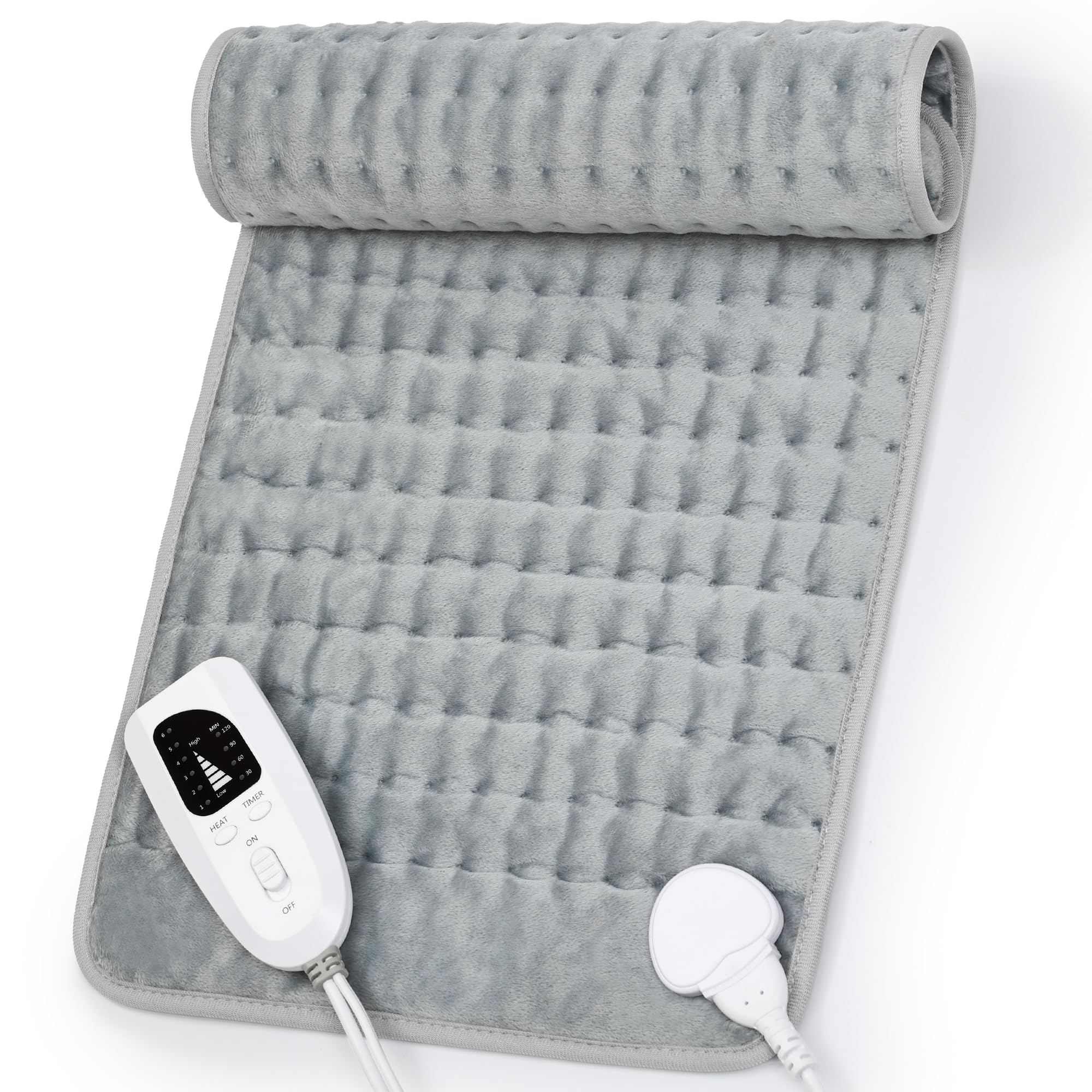
The pad we reach for after a couple of hours of pick-up games is this one. At 24 by 12 inches it wraps a thigh or covers a lower back without needing a second pair of hands, and the flannel face is soft enough to lie against bare skin. It is inexpensive enough that keeping a second one in a gym bag is not a stretch, which is most of the pitch.
Six heat levels and four timers — 30, 60, 90, and 120 minutes — give it more control than most pads here. The top two levels are where we spend our time, and they run warm rather than fierce: plenty through a sweatshirt, less than you would want on bare skin when a quad is genuinely locked up. That is the one place this pad is ordinary, and if intense heat is what you are after, the Thermophore is the one to read next.
The timer matters more than the heat settings, honestly. A 20-minute cutoff is fine for a wrist and useless for a back that seized on a Sunday afternoon; being able to set two hours means you can work through a whole game on TV without the pad clicking off halfway. The 75-inch cord reaches from a floor outlet to the far end of a sofa. And after three consecutive nights against a sweaty back, you disconnect the controller and put the whole thing in the machine.
The 24-by-12 shape is the useful compromise: long enough to wrap a thigh completely, short enough that it does not bunch when you shift position. We used it flat under a lower back and draped over a shoulder, and it stayed where we put it both ways. Roll it for storage rather than folding it, and it keeps its shape between sessions.
Pros
- Wraps a thigh or lower back unaided
- Timers from 30 to 120 minutes
- Machine washable after unplugging
- Low cost for a full-size pad
Cons
- Dry heat only, with no moist option
Full-size coverage, four timer lengths, and a cover that goes in the wash — we make this the default because it does the three things a recovery pad has to do.
CooCoCo 17 x 33 Heating Pad – Best for Full-Back Coverage
Key Features
- Size: 17 x 33 in
- Timers: 30, 60, 90 min
- Heat modes: Dry or moist
- Heat settings: 6
- Price: Midrange
Seventeen by thirty-three inches is not a typo, and it changes what the pad is for. Laid across a bed it covers a whole back and both shoulders at once; draped over a thigh it reaches from hip to knee with fabric to spare. If you have been making do with a 12-inch-wide pad and shifting it every five minutes, the difference is obvious the first time you use it.
We like it most for the parts of recovery that involve lying still: it is the only pad here that heats both hamstrings at the same time, and the moist mode adds a heavier, more penetrating feel than dry heat manages. Six heat levels and 30, 60, or 90-minute timers are a shorter menu than the top pick offers, but we never wanted for a setting.
The cover is padded rather than slick, so it grips a sweaty back instead of sliding off it, and it goes in the washing machine once the controller is unplugged. Ninety minutes is the longest single session, so an all-evening sofa night means pressing a button once more.
Pros
- 17 x 33 inches covers a whole back
- Dry or moist heat modes
- Washable padded cover
Cons
- Too much pad for a knee or shoulder
We keep this one for the days when a standard pad is not enough coverage; it is the biggest pad here and the only one that heats a whole back at once.
Thermophore MaxHEAT Moist Heat Pad – Best for Deep Moist Heat
Key Features
- Size: 14 x 27 in
- Weight: 2 lb
- Auto-off: 25 min
- Heat settings: 3
- Price: Premium
There is heat, and then there is the feeling of a hot towel straight out of the dryer pressed against a hamstring. The Thermophore is the only pad here that gets to the second one. It is 14 by 27 inches, with three settings and a thermostat switch, and it produces moist heat without you adding a drop of water.
That moisture is the whole trick. Dry electric pads warm the surface of the skin; this one feels as though it is pushing heat a half inch deeper, and on a chronic lower back or an old knee it is a different category of relief. Two pounds of pad also means it stays exactly where you drop it, which is more than the flat pads manage when you shift on a couch.
The catch is the 25-minute auto-off. Twenty-five minutes is one stiff muscle and a half, and for a back that needs forty you will be pressing the switch again mid-session. We minded that less than we expected, because the heat is intense enough that twenty-five minutes does real work — but if you want to set something and drift off, this is not the pad for that.
It also costs more than anything else here, and it feels it in the hand: heavier fabric, a proper switch, a cord that belongs on an appliance rather than a gadget. Whether that is worth paying for depends on whether ordinary dry heat has ever actually done the job for you. On the bad days it is the pad we take off the shelf first, and the flat pads handle the rest.
Pros
- Most intense moist heat in this group
- Heavy enough to stay where you put it
- 14 x 27 inches of coverage
- Three constant, thermostat-held settings
Cons
- Cuts off after 25 minutes
When heat is the point and budget is not the constraint, we send you here — nothing else in this group gets as deep into a tight muscle.
LEATIGIO Wearable Heating Pad – Best Wearable for Lower Back
Key Features
- Design: Wearable belt, dual zone
- Fabric: Double-sided coral fleece
- Heat settings: 6
- Temperature range: 104°F to 140°F
- Price: Midrange
Wearing a heating pad is a different experience from lying on one, and for a lower back that stiffens up after games it is the better one. This is a belt: strap it around your waist, cinch the front, and the heat sits against your lumbar spine while you make coffee, answer email, or pace the hallway waiting for the stiffness to let go.
Two heating zones warm the lower back and the abdomen at once, which sounds like overkill until you have spent an evening hunched over a laptop. Six levels run from 104°F to 140°F, there is a timer you can set and forget, and the whole thing is coral fleece — soft enough to wear against skin for an hour without noticing it is there.
Where it earns its keep is the hands-free part. A flat pad on a lower back stays on for about as long as you stay still; this one goes where you go, and we noticed the difference most on the days when sitting still was not an option. It will not wrap a thigh or a shoulder, and it is not built for a whole back. Within that narrow job, nothing else here does it as comfortably.
Pros
- Hands-free heat on a lower back
- Warms back and abdomen together
- Six levels from 104°F to 140°F
Cons
- Belt runs loose on smaller frames
For a lower back that seizes after games, this is what we hand people: it straps on and stays put while you move around the house.
Telepepe Heated Knee Brace – Best for Knees
Key Features
- Battery: 3000 mAh
- Closure: Adjustable Velcro straps
- Charge time: About 4 hours
- Temperature modes: 104–107°F, 107–125°F, 125–143°F
- Price: Midrange
A heated knee brace looks like a gadget until you have had a knee that aches every time you stand up after a game. This one is a black wrap with three heat modes, a 3000 mAh battery that sits in a small pouch, and Velcro straps that go above and below the knee. It heats to a stated 143°F, which is enough to feel through a pair of sweatpants.
The freedom is what sold us: no cord, no outlet, no lying down. You strap it on, walk around the house, and it stays where you put it through a set of quad stretches. What to plan around is the battery — four hours on the charger buys a handful of sessions, so it is a nightly charging habit rather than something you can leave in a gym bag for a week. And it is a knee brace; nobody is wrapping it around a lower back.
Pros
- Cordless, with a 3000 mAh battery
- Three modes up to 143°F
- Straps keep it on while you move
Cons
- A charge covers only a few sessions
The pad we put on a cranky knee: cordless, strapped in place, and warm enough at the top setting to feel like it is working.
VANKADA Electric Heating Pad – Long Cord Reach

Key Features
- Cord: 7.2 ft
- Size: 24 x 12 in
- Timers: 30, 60, 90, 120 min
- Heat levels: 6
- Price: Budget
The first thing to know about this pad is that it shares a model number with our top pick. As far as we can tell they are the same 24-by-12-inch pad from the same line, sold under different names, and they behave the same way in use: six levels, four timers from 30 to 120 minutes, soft flannel, machine washable once the controller comes off.
The differences are small and specific. The cord is 7.2 feet rather than 75 inches — about a foot more reach, which is the difference between a pad that works on the couch and one that works on the couch and the armchair beside it. On the unit we used, the top settings felt a touch more assertive than our top pick’s, though with one shared design that is a unit-to-unit thing rather than a reason to switch.
So it earns a place as an alternative rather than a second recommendation. If the cord length solves a real problem for you, buy it and do not think twice. If it does not, the two pads are close enough to be interchangeable, and you can take whichever listing is in stock.
Pros
- 7.2-foot cord reaches across a room
- Six heat levels and four timers
- Washable flannel cover
Cons
As far as we can tell this is our top pick with a longer cord, and that is the only reason to choose it over the pad above.
SuzziPad Microwavable Heat Pack – Cordless Spot Relief

Key Features
- Fill: Flaxseed, millet, clay beads
- Size: 6.5 x 12 in
- Warm-up: 90 seconds
- Heat time: Up to 20 min
- Price: Budget
Ninety seconds in a microwave and you have heat with no cord attached to it. That is the appeal of a grain-filled pack, and the SuzziPad is the best-executed one here: 6.5 by 12 inches of flaxseed, millet, and clay beads in a velvet cover, soft on one side and woven on the other.
It molds. That is the word that matters for a knee, a wrist, or the top of a shoulder — a flat electric pad sits on the outside of the curve and leaves a gap, while this drapes into it and stays. The sectioned interior keeps the fill from sliding down to one end, which is what happens with a loose pack.
The heat itself is wet and heavy, closer to the Thermophore’s feel than to a dry electric pad, and it fades to a comfortable warm long before you are ready to move. A couple more minutes in the microwave resets it, so the rhythm is warm up, settle, reheat rather than a two-hour session on the couch. We like it best on a shoulder, where the weight of the fill sits against the muscle.
The fill gives off a faint, grainy smell for the first few uses; it fades, but it is worth knowing if you are sensitive. Otherwise this is the pad that lives in the car while the electric ones stay by the sofa.
Pros
- Cordless, with a 90-second warm-up
- Molds around a knee, wrist, or shoulder
- Works as a cold pack too
Cons
- Too small for a back or thigh
For the places a cord will not reach, this is the one: ninety seconds in a microwave buys about twenty minutes of moist heat.
How We Tested the Best Heating Pads for Basketball Players
We started by gathering every heating pad a basketball player would realistically buy — moist-heat and dry, weighted and flat, corded and cordless — then cut anything with a fixed shut-off under 15 minutes, a single heat setting, or a cover that couldn’t be washed. That left 12 pads, from budget drugstore picks to the heavier models marketed at athletes, which we used for six months.
Testing happened where the pads actually live. Before practices, players draped them over a tight lower back or a sore shoulder while stretching and told us whether the warmth reached deep into the muscle or just sat on the skin. After games, we used them on the couch and in the car, checking whether heat spread evenly across the whole pad or pooled in one hot strip, and asking the next morning whether a stiff back had actually loosened. We logged every auto shut-off too — how long it ran, whether it beeped, and whether it could be reset without unplugging the thing.
Softness and size got judged the hard way: bare skin, still sweaty, ten minutes after a run. Fabric that felt plush on the shelf sometimes turned clammy, and a generously sized pad was useless if it slid off a thigh mid-stretch. We stuffed each one into a gym bag weekly, folded it the way people actually fold things, and tugged the cords to see how the connections held up over weeks. Then we weighed all of it against price — the plainest pad in the group costs less than a post-game meal, and a couple of the fanciest ones couldn’t match it on heat retention.
How to Choose a Heating Pad for Recovery
The right pad covers the area that hurts and holds heat there for longer than a quarter of an hour; brand, colour, and controller are detail.
Coverage comes before everything else
A 24-by-12-inch pad is the workhorse of this group: laid across a lower back it covers the whole lumbar curve, and draped over a thigh it reaches from hip to knee. Go bigger, as the 17-by-33-inch CooCoCo does, and you can heat a whole back or both hamstrings at once — but that much fabric is clumsy around a shoulder or a knee. Go smaller, like the 6.5-by-12 SuzziPad, and you get a pack that molds to a joint and does nothing for a back.
The trap is buying on square inches alone. A pad that is too big for the joint you are targeting slides off it, and you spend the session holding it in place instead of recovering. Measure the part that hurts before you pick the size.
How hot it gets at the top end
Most electric pads here top out somewhere between 104°F and 143°F, and that range is wider than it sounds — the bottom is a warm blanket, the top is heat you feel through a sweatshirt. Ignore the number of settings and look at where a pad’s ceiling sits, because the top two levels are the ones you reach for when a muscle is genuinely tight.
Our preference is to buy for the top end and let the low settings look after themselves, since every pad here is easy to live with at the bottom of its range. Six levels often means only three feel distinct, so treat the count as marketing and the ceiling as the spec.
Timers and auto-off are a feature, not a fault
Every pad here switches itself off, and that is a safety design rather than a limitation. What varies is when. A 20-to-25-minute cutoff, like the Thermophore’s, suits one stiff muscle and interrupts a long session on a back; pads with 30, 60, 90, and 120-minute menus let you settle in for a whole game.
If your recovery happens in front of a TV, prioritize the longer menu. If you use heat in short targeted bursts between stretches, a 25-minute cap costs you nothing and keeps you from leaving the thing running.
Cord, battery, or microwave
The power source decides where you can use the pad. A corded pad gives unlimited heat for as long as the timer allows, so check the reach against where you actually sit — 75 inches and 7.2 feet behave very differently in a room with one distant outlet.
A battery wrap like the Telepepe lets you walk around, at the cost of a four-hour charge for a handful of sessions. A microwave pack like the SuzziPad is cordless and cheap, and gives you roughly twenty minutes per warm-up — right for a locker room, wrong for a two-hour evening on the sofa.
Fabric, sweat, and washing
Flannel and plush covers are what make a pad comfortable enough to keep on for an hour, and heat plus a sweaty back becomes a cleaning problem within a week. Most electric pads here are machine washable once you disconnect the controller: unplug it, wash cold, and let the pad dry completely before the controller goes back on.
Wraps are the exception, so check before you buy one you will sweat on. Store a pad rolled rather than folded, and never fold or lie on one while it is heating.
Frequently Asked Questions
Is heat or ice better after a basketball game?
Ice first for anything that swells — a rolled ankle, a knock to the knee, a joint that is puffy and warm within a day. Heat is for the day after, for muscles that are tight and stiff rather than swollen. The test is simple: press the area. If it is puffy and hot to the touch, keep the pad off it and use cold.
How long should a heating pad last?
There is no printed lifespan, and the pads here vary enormously. What matters is behaviour: a pad that blinks, cuts out mid-session, heats unevenly, or has a cord that feels warm near the controller is finished rather than fixable. Stop using it and use the return window. A listing with a warranty you can actually claim is worth more than a slightly cheaper one.
Can I use a heating pad directly on my skin?
Yes, at the low and middle settings, and that is how most people use one. The risk sits at the top of the range and in long sessions, where a burn creeps in before it hurts. Start with a thin layer of cotton between pad and skin, then go bare once you know how that particular pad behaves on your body.
Final Verdict
If you want one pad and no further thinking about it, buy the Deepsoon 24-by-12. It covers a thigh or a lower back, it runs for up to two hours on a timer, and the cover goes in the wash — the three things that decide whether a heating pad gets used or ends up in a closet.
If your soreness sits in one knee, the Telepepe’s cordless wrap will do more for you than any flat pad can. And if ordinary heat has never quite been enough, the Thermophore is the one that feels like something.